
How to Size a Solar Battery (kWh) for Your Night-Time Load
🌏 This article is available in another language: ไทย
Size a solar battery step by step: energy used without sun, depth of discharge, efficiency and ageing, then check the solar surplus and the power rating.
"How many kWh of battery does my home need?" is a question you can get wrong in both directions. Too small, and the battery is empty by nine o'clock and the house goes back to buying grid power. Too big, and the customer pays for capacity they never use, because the panels cannot refill it.
This guide shows how to size a battery for a solar system step by step: working out the night-time consumption, allowing for depth of discharge and efficiency, and checking that the panels can recharge it, with an example you can follow.
In short ✅ Start from the energy used when there is no sun, not the whole monthly bill ✅ Capacity to buy = night-time use ÷ (DoD × efficiency), plus a margin for ageing ✅ Check that the daytime solar surplus is large enough to refill the battery ✅ Check the power rating (kW) for loads that run at the same time, not only the capacity (kWh) ✅ Off-grid systems also need extra days of autonomy for cloudy spells
Why calculate instead of picking the best-seller
In a hybrid system the battery stores the surplus the panels produce in the daytime and releases it from evening to morning. The chart below shows one day in a home with a battery: the green area is surplus solar going into the battery, the blue area is the battery supplying the home when there is no sun.
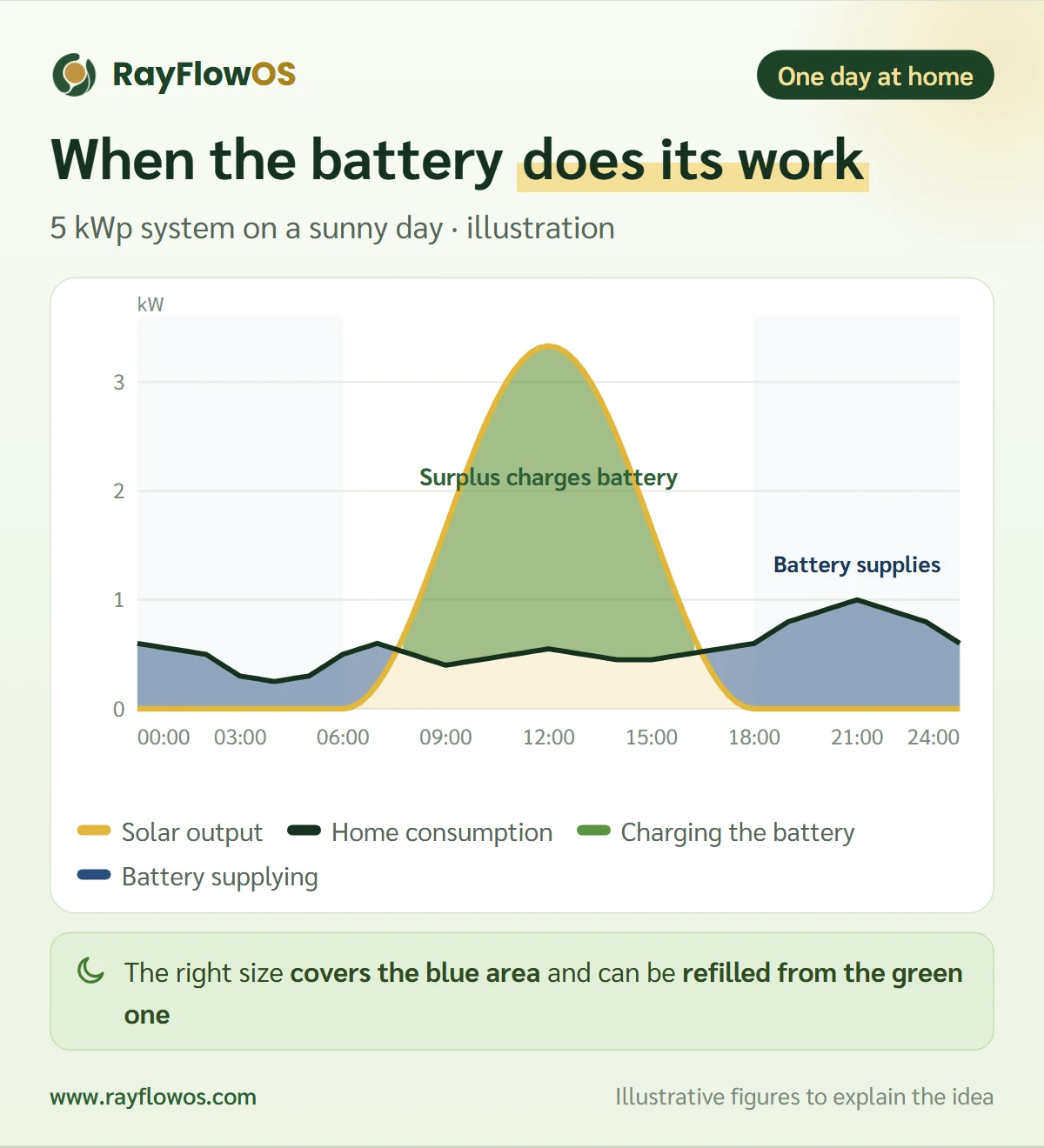
The right size covers the blue area and can still be refilled from the green one.
Five steps to size a battery
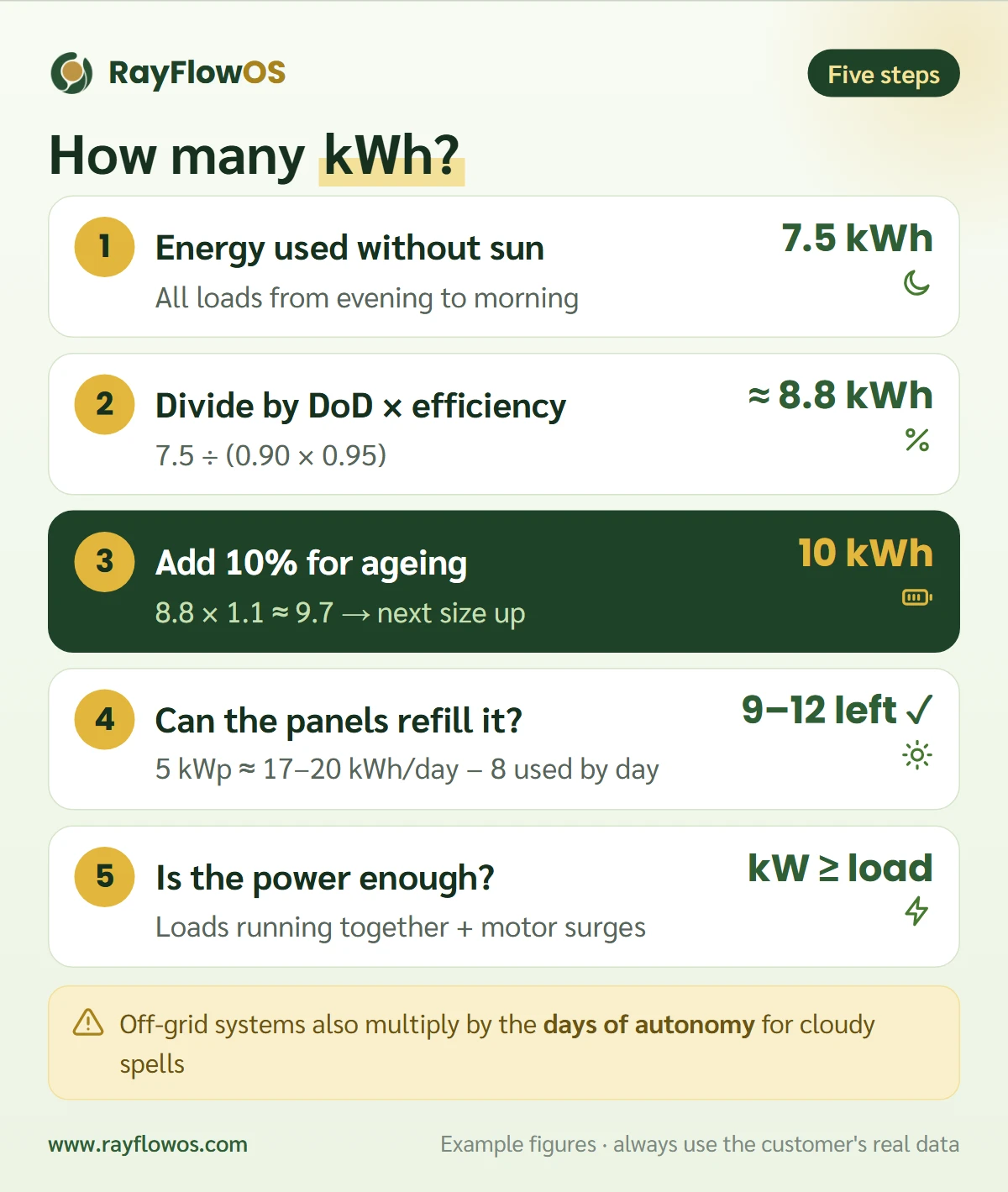
Step 1: Find the energy used without sun
Use real data first. A time-of-use meter or the inverter's app shows consumption by time of day. Without them, list the appliances that run from evening to morning.
| Appliance (example) | Average power | Hours | Energy (kWh) |
|---|---|---|---|
| One air conditioner | 900 W | 6 | 5.4 |
| Refrigerator | 60 W | 12 | 0.7 |
| LED lighting | 100 W | 5 | 0.5 |
| TV and router | 150 W | 4 | 0.6 |
| Water pump and others | 300 W | 1 | 0.3 |
| Total | 7.5 |
These figures are examples. Use the appliance labels or meter readings for real numbers.
Step 2: Divide by depth of discharge and efficiency
A battery cannot deliver 100% of its capacity, and energy is lost while charging and discharging. Assume an LFP battery with 90% usable depth of discharge and 95% round-trip efficiency:
Required capacity = 7.5 ÷ (0.90 × 0.95) ≈ 8.8 kWh
Step 3: Add a margin for ageing
Every battery stores less as it ages. A margin of about 10–20% keeps the later years comfortable. With 10% we get about 9.7 kWh, so we choose a 10 kWh battery.
Step 4: Check that the panels can refill it
A large battery is useless if there is no daytime surplus to charge it. Studies of rooftop systems in Thailand report roughly 3.4–4 kWh per kWp per day on average, depending on orientation and location (a model of grid-connected PV in Thailand · a 9.8 kWp rooftop at different orientations). A 5 kWp system therefore makes about 17–20 kWh on a normal sunny day. If the home uses 8 kWh during the day, about 9–12 kWh is left, enough to refill the roughly 8 kWh the battery delivered overnight.
Step 5: Check the power rating (kW)
Capacity (kWh) says how long the battery lasts; power (kW) says how many appliances can run at once. Add up the loads that might run together, and choose a battery and inverter whose continuous output exceeds that. Motor loads such as pumps and air conditioners draw a surge when they start, so check the surge rating too.
Off-grid needs more margin
An off-grid system has no grid to fall back on when the battery runs out, so it must cover cloudy spells, known as days of autonomy:
Off-grid capacity = daily use × days of autonomy ÷ (DoD × efficiency)
It also needs enough panels to refill the battery after rainy days (see on-grid vs off-grid vs hybrid).
Common mistakes
- Dividing the monthly bill by thirty and buying a battery for the whole day's use, although daytime use already runs on solar.
- Looking at total capacity instead of usable capacity.
- Forgetting to check whether there is enough surplus to recharge.
- Forgetting the maximum power, so the system trips when the air conditioner and pump start together.
- Installing the battery somewhere hot, so it ages faster than planned (compare chemistries in our battery comparison).
How installers use RayFlowOS for this
- Customer records have a field for the battery size (kWh) the customer is interested in, so sales knows what the customer is looking for from the start.
- Site surveys keep past electricity bills and site photos, the raw data for the calculation.
- Quotations list the chosen battery model from your product list, with its size and warranty terms.
- Warranties and serial numbers let you follow each battery through its whole life.
FAQ
What battery size does an average home need?
There is no single number. It depends on consumption when there is no sun: a home that runs a bedroom air conditioner all night needs several times more than one that only runs lights and a fridge. Calculate from the actual home's data.
How many hours does a 10 kWh battery last?
Divide the usable capacity by the power being drawn. A battery with about 9 kWh usable supplies a home drawing an average of 1 kW for about nine hours.
Will a battery eliminate my electricity bill?
Usually not entirely. Rainy days produce less, and the meter has a monthly service charge. A battery mainly cuts the grid power bought from evening to morning.
Should I buy a bigger battery for the future?
Not necessarily. If the panels cannot refill it, the extra capacity goes unused. Many systems let you add battery modules later, so choose an expandable model instead.
Should I recalculate after buying an air conditioner or an electric car?
Yes. Your consumption when there is no sun changes significantly.
The bottom line
A well-sized battery starts from the energy used without sun, divided by depth of discharge and efficiency, plus an ageing margin, followed by two checks people forget: can the panels refill it, and is the power rating enough for loads that run together. Calculate from the customer's real data and you get a system that lasts the night without overspending.
Start using RayFlowOS for free and keep every customer's battery details in one place →