
LiFePO4 vs NMC vs Lead-Acid: Choosing a Solar Battery
🌏 This article is available in another language: ไทย
LFP, NMC and lead-acid solar batteries compared on cycle life, usable capacity, safety and lifetime cost per kWh, plus what to check in the data sheet.
The battery is one of the most expensive parts of a hybrid or off-grid solar system, yet most customers choose one on price per kilowatt-hour alone. Two batteries with the same capacity can last several times longer than each other, because the chemistry inside is different.
This article compares the three battery types you meet most often in solar work, lithium iron phosphate (LiFePO4, or LFP), lithium NMC and lead-acid: how they differ, which suits homes in a hot climate like Thailand's, and what to read in the spec sheet before you buy.
In short ✅ LFP lasts the most cycles, handles heat well and is very safe, which is why it dominates home energy storage ✅ NMC packs more energy into less space, useful when space is tight, but it is more sensitive to heat ✅ Lead-acid is cheap up front, but you can only use about half its capacity and it wears out much sooner ✅ Compare batteries by the cost of each unit stored over their life, not by purchase price ✅ Read the whole data sheet: cycles, depth of discharge, temperature range and warranty terms
The main types of solar battery
LiFePO4 (LFP)
A lithium battery with an iron-phosphate cathode. Its chemistry is very stable, it tolerates full daily cycling well, and it is far less prone to thermal runaway than other lithium chemistries. Most new home batteries use it.
NMC (nickel manganese cobalt)
A lithium chemistry with high energy density: more storage in less weight and space, which is why electric cars use it. It is more sensitive than LFP to heat and to deep cycling.
Lead-acid
The older technology with a low upfront price. Flooded types need topping up with distilled water; sealed AGM and gel types do not. You should use only about half of the capacity or the battery ages quickly, and flooded batteries give off hydrogen while charging, so they need a ventilated space.
Side-by-side comparison
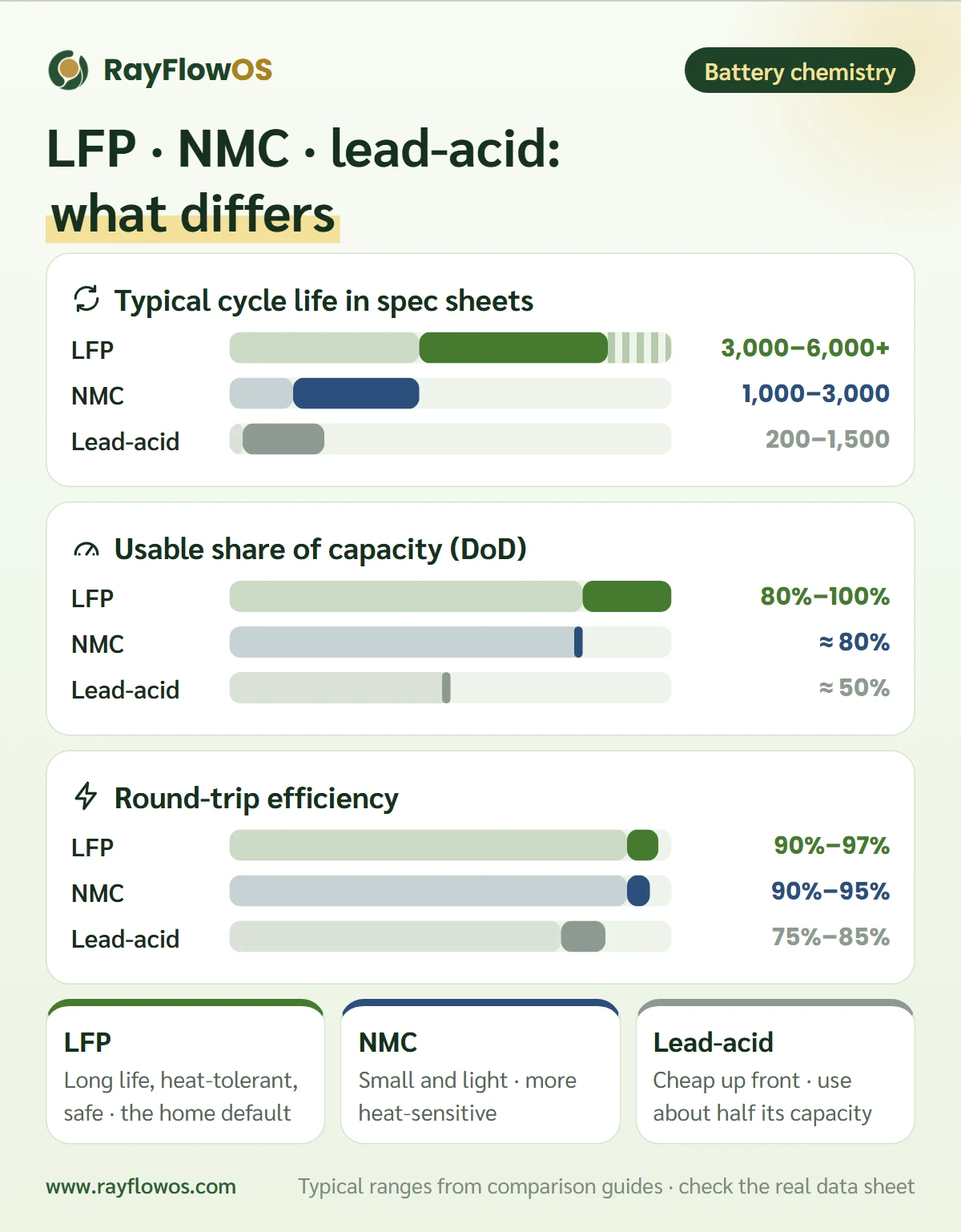
| Topic | LFP | NMC | Lead-acid |
|---|---|---|---|
| Typical cycle life in spec sheets | About 3,000–6,000+ | About 1,000–3,000 | About 200–1,500 |
| Usable depth of discharge | 80–100% | About 80% | About 50% |
| Round-trip efficiency | 90%+ | 90%+ | About 75–85% |
| Heat tolerance and safety | Very good | Moderate | Moderate, needs ventilation |
| Size and weight | Medium | Smallest and lightest | Largest and heaviest |
| Upfront price | Medium | Medium to high | Low |
These are typical ranges from comparison guides, and they depend on the test conditions: depth of discharge, temperature and the capacity threshold that counts as end of life. Use them for orientation only, and check the data sheet of the actual model. Independent testing of commercial cells points the same way: LFP degraded more slowly than NMC and was less sensitive to deep cycling (Preger et al., Journal of The Electrochemical Society, 2020).
Working out what a battery really costs
The purchase price does not tell you which battery is the better deal. Compare the cost per unit of energy stored over the battery's life.
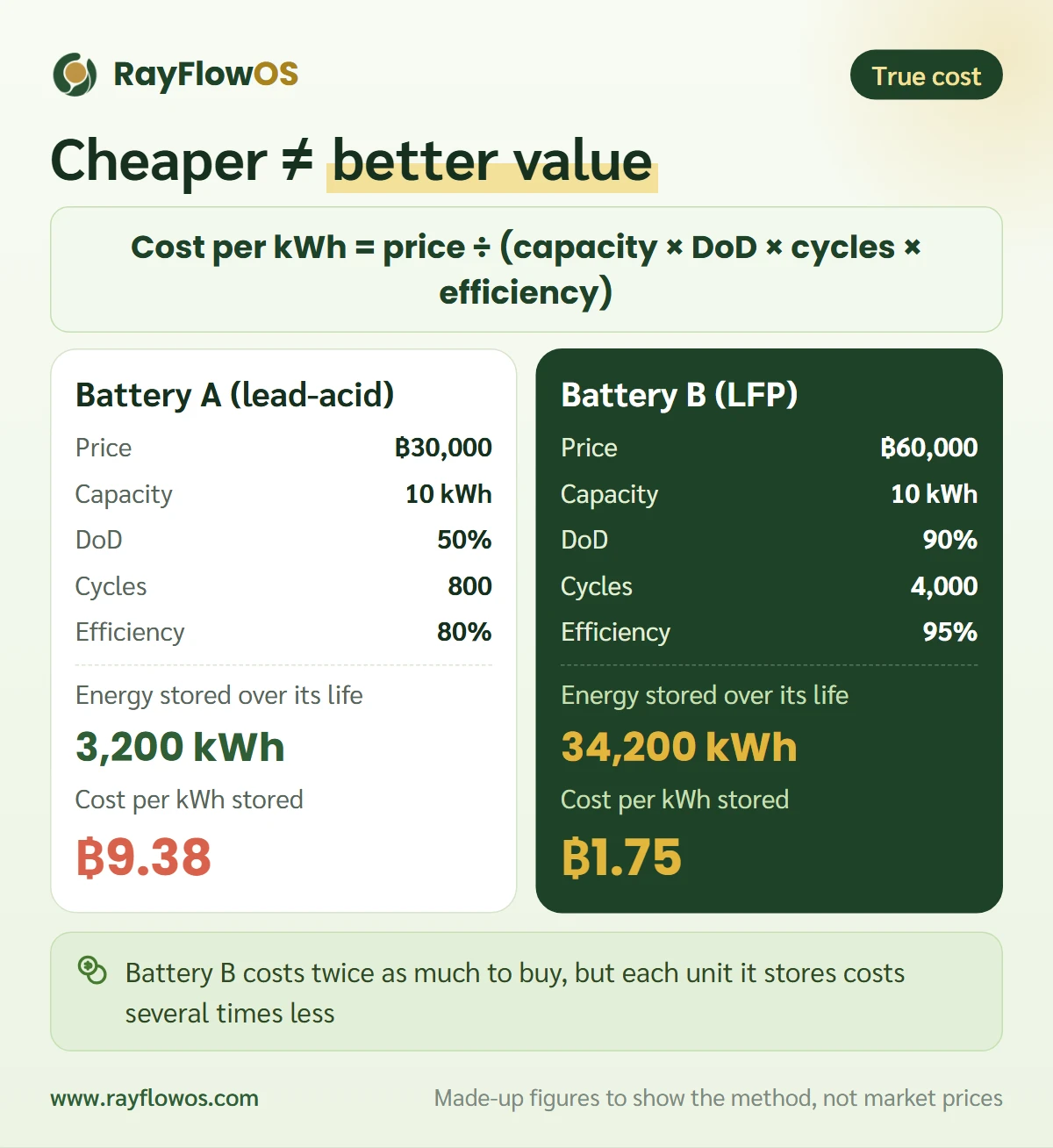
Cost per kWh stored = battery price ÷ (capacity × DoD × cycles × efficiency)
With made-up numbers: battery A costs half as much, but you can use only half its capacity and it lasts a fraction of the cycles. Over its life, every unit it stores costs more than with battery B, despite B's higher price. That is why most new systems use LFP.
Hot climates: what to watch
- Heat speeds up ageing for every chemistry. Install batteries in the shade, out of direct sun, with airflow.
- Check the operating temperature range on the data sheet, and avoid rooms where heat builds up, such as an unventilated attic.
- The battery management system (BMS) of a lithium battery must work with the inverter. Check the inverter maker's list of compatible battery models.
- Flooded lead-acid batteries need ventilation because of the hydrogen released during charging, and regular topping up with distilled water.
What to read in the data sheet and warranty
- Usable capacity, not just total capacity.
- Cycle count, and at what depth of discharge. 6,000 cycles at 90% is not the same as 6,000 cycles at 50%.
- Capacity guaranteed at the end of the warranty, as a percentage.
- Warranty term in years or in energy throughput, whichever comes first.
- Operating temperature range and maximum continuous power (kW).
- Compatible inverters.
To size the battery for a home, follow our battery sizing guide. Batteries belong in off-grid and hybrid systems (see how they differ).
Looking after the battery
Check its status regularly in the app or on the inverter display: any BMS alarms, unusually high temperatures, or capacity dropping faster than expected. Our solar and battery maintenance checklist has the details.
Managing batteries as an installer with RayFlowOS
- The customer record stores the battery size the customer is interested in from day one.
- Every battery is traceable by serial number from goods receipt to installation (read about stock and serials).
- The warranty menu issues system and battery warranties to customers, with reminders before they expire.
- Batteries that fail under warranty go through product claims and are kept in the claim store.
FAQ
How many years does an LFP battery last?
It depends on cycles per day, temperature and depth of discharge. At one cycle a day, a rating of several thousand cycles means many years, but the warranty term and guaranteed capacity of the specific model are what you should rely on.
Is NMC dangerous?
Not when it is a standard product with a good BMS, installed correctly. It is, however, more heat-sensitive than LFP, so for homes in a hot climate LFP is usually the more comfortable choice.
Is lead-acid still worth using?
For small, low-budget or rarely used systems, such as backup power where outages are rare. For daily cycling with solar, lithium is usually cheaper over its life.
Can I mix a battery brand with any inverter?
Only pairs the manufacturers certify as compatible. Otherwise the system may underperform or the warranty may be void.
The bottom line
For home solar with daily cycling, LFP offers the best balance of life, safety and lifetime cost. NMC fits when space is tight, and lead-acid suits small systems that rarely cycle. Whatever you choose, compare by cost per unit stored and read the warranty terms in full.
Start using RayFlowOS for free and track every battery by serial number and warranty →