
Solar and Battery Maintenance After Installation: An O&M Checklist
🌏 This article is available in another language: ไทย
A monthly, quarterly and yearly checklist for solar systems and batteries, safety cautions, and how installers turn maintenance into after-sales service.
Many people think a solar system needs no attention once it is installed. In reality, unattended systems often produce less and less without anyone noticing: dust builds up on the panels, rodents chew the cables, the inverter shows a warning for months, or a battery runs hot because it was installed in the wrong place. By the time someone notices, a lot of money has gone on electricity bills.
This article is a maintenance checklist for solar systems and batteries after installation: what to do and how often, and how installers can turn maintenance into an after-sales service that earns recurring income and referrals.
In short ✅ Check production in the app every month and compare it with the same month last year ✅ Clean the panels as often as local dust requires, with clean water and a soft brush, early or late in the day ✅ Inspect cables, connectors, mounts, the inverter and the battery at least once a year ✅ Leave roof work and electrical work to trained technicians with safety equipment ✅ Record every service visit; it is your evidence for warranty claims
Why solar systems need maintenance
- Output drops silently. The system keeps running but produces less than it should, and nobody knows unless they look at the numbers.
- Safety. Loose connectors or damaged insulation can overheat.
- Warranties. Some manufacturers set installation and care conditions; service records help when you claim.
- Longer battery life, when batteries stay within their temperature range and no alarms are left unresolved.
Maintenance checklist by interval
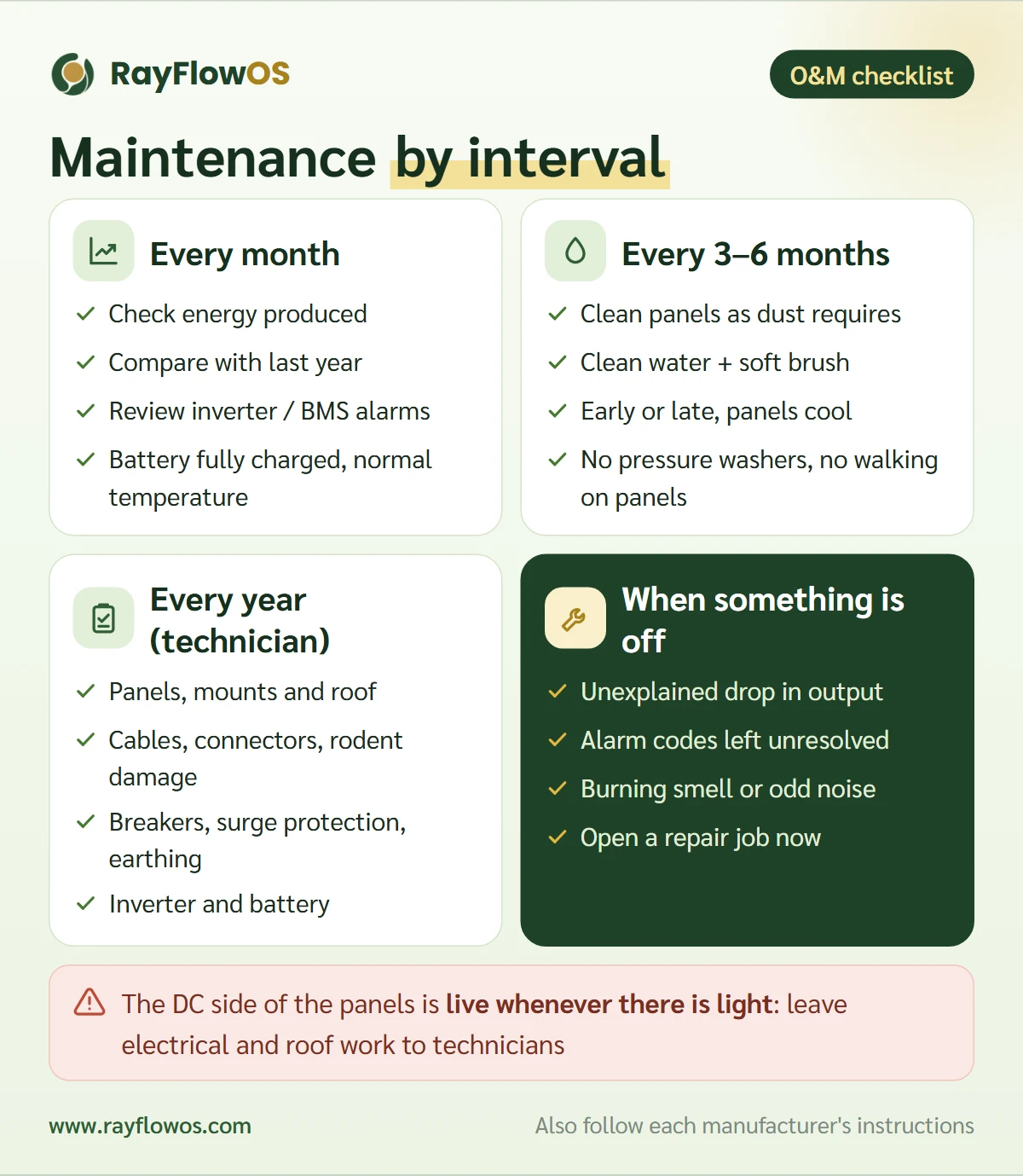
Every month: check the numbers
- Open the app or the inverter display and note the energy produced this month.
- Compare it with the same month last year. A large drop that the weather does not explain means something is wrong.
- Review the alarms from the inverter and the battery management system (BMS).
- For battery systems, check that the battery reaches full charge on sunny days and that its temperature is normal.
Every three to six months: clean the panels as conditions require
How often depends on dust. Homes near dirt roads, farms, factories or places with bird droppings may need more frequent cleaning, while heavy rain does part of the job in the wet season.
- Use clean water with a soft brush or sponge.
- Clean early in the morning or late in the afternoon, when the panels are cool.
- No high-pressure water, harsh chemicals, or walking on the panels.
- Follow the manufacturer's instructions for the model.
Every year: a technician's inspection
- Panels: cracks, burn marks, stains that do not wash off, and new shading such as growing trees.
- Mounts and roof: loose bolts, rust, leaks around the fixing points.
- Cables and connectors: cracked insulation, loose connectors, signs of rodents.
- Protection: breakers, surge protection devices and earthing.
- Inverter: vents, fans and the alarm history.
- Battery: temperature, ventilation, BMS messages and the capacity it reaches compared with installation day (see the chemistry-specific cautions in our battery comparison).
Larger systems can use a thermal camera to find hot spots on panels or connectors before they are visible to the eye.
Safety comes first
Roof work carries a fall risk, and the DC side of the panels stays live as long as there is light, even with the house breaker switched off. Connector checks, work inside distribution boards and battery work belong to trained technicians with protective equipment. Homeowners should limit themselves to watching the numbers and cleaning panels they can reach safely.
Turning maintenance into an after-sales service
For installers, the work after handover is not just an obligation; it is a business opportunity.
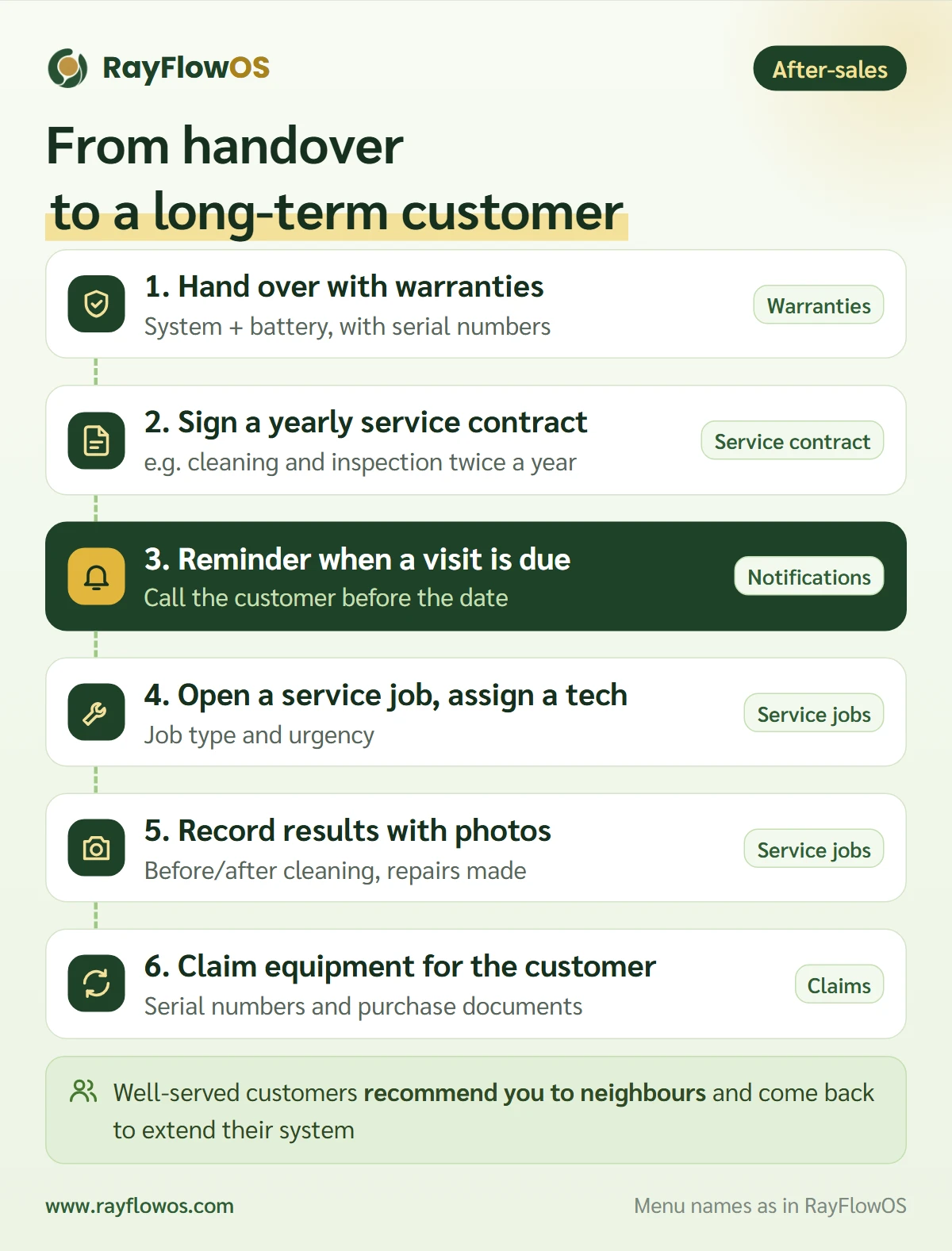
- Hand over with complete documents: system and battery warranties, with the serial numbers of the main equipment.
- Offer a yearly service contract, for example cleaning and inspection twice a year: predictable recurring income.
- Get reminded before each visit, and call the customer to book it instead of waiting for them to call with a problem.
- Open a service job every time, with the job type, urgency and the technician responsible.
- Record the results with photos: before and after cleaning, the readings taken and what was repaired.
- Handle warranty claims for the customer using the serial numbers and purchase documents you kept (read about stock and serials).
Customers who are looked after well recommend you to their neighbours and come back to you for a battery or an extension.
After-sales work in RayFlowOS
RayFlowOS covers the work after handover in the same system as sales and installation:
- After-sales service jobs in three types: repair or system fault, scheduled maintenance, and inspection or panel cleaning, with priority, technician assignment and status tracking until the job is closed.
- Service contracts with the next visit date and a reminder as it approaches.
- System and battery warranties and fire insurance policies, with reminders before they expire.
- Product claims, tracking each unit sent for claim by serial number.
- Site photos and documents can be attached to every job.
Reminders are part of plans that include notifications; see the plans on our website.
FAQ
How often should solar panels be cleaned?
It depends on local dust; many sites clean every three to six months, and dusty areas more often. The best guide is the production figure: an unusual drop in the dry season means it is time.
Can I clean the panels myself?
Yes, if you can reach them safely. Use clean water and a soft brush while the panels are cool. On high or steep roofs, leave it to a technician with fall protection.
The inverter shows a warning. What should I do?
Note the code or message and contact your installer. Do not open the inverter yourself; there is high voltage on both the panel side and the house side.
What does a battery need?
Keep it in the shade with airflow, make sure no BMS alarms are left unresolved, and update the firmware as the manufacturer recommends. Flooded lead-acid batteries also need regular topping up with distilled water.
Should installers charge for yearly maintenance?
It is worth offering. It keeps the customer's system producing at its best and gives your company recurring income. The price depends on system size, travel distance and visits per year.
The bottom line
A solar system that is maintained regularly produces more and is safer. Check the numbers monthly, clean the panels as local conditions require, and have a technician inspect the system every year. For installers, an after-sales system that reminds you of every visit and keeps a full history is what turns a one-off job into a long-term customer.
Start using RayFlowOS for free and run after-sales service the organised way →