
On-Grid vs Off-Grid vs Hybrid Solar: Which System Fits?
🌏 This article is available in another language: ไทย
How on-grid, off-grid and hybrid solar systems differ: power flow, behaviour in a blackout, grid approval and the customers each one suits.
The first question homeowners and business owners ask about solar is which kind of system to buy: on-grid, off-grid or hybrid. The names sound alike, but the three differ a lot in price, in what happens during a power cut, and in what the utility will allow.
This article explains all three: how the electricity flows, who each one suits, the trade-offs, and what an installer should ask the customer before proposing a system.
In short ✅ On-grid: connected to the utility, no battery, the cheapest, but it shuts down during a power cut ✅ Off-grid: not connected to the utility, stores energy in batteries; made for places without grid power ✅ Hybrid: connected to the utility and has a battery; stores daytime solar for the evening and can back up the house during outages if the inverter supports it ✅ Homes that use most power in the daytime can start on-grid; heavy evening use or frequent outages point to hybrid ✅ Grid-connected systems need the utility's approval and equipment the utility accepts
How the power flows in each system
On-grid (grid-tied)
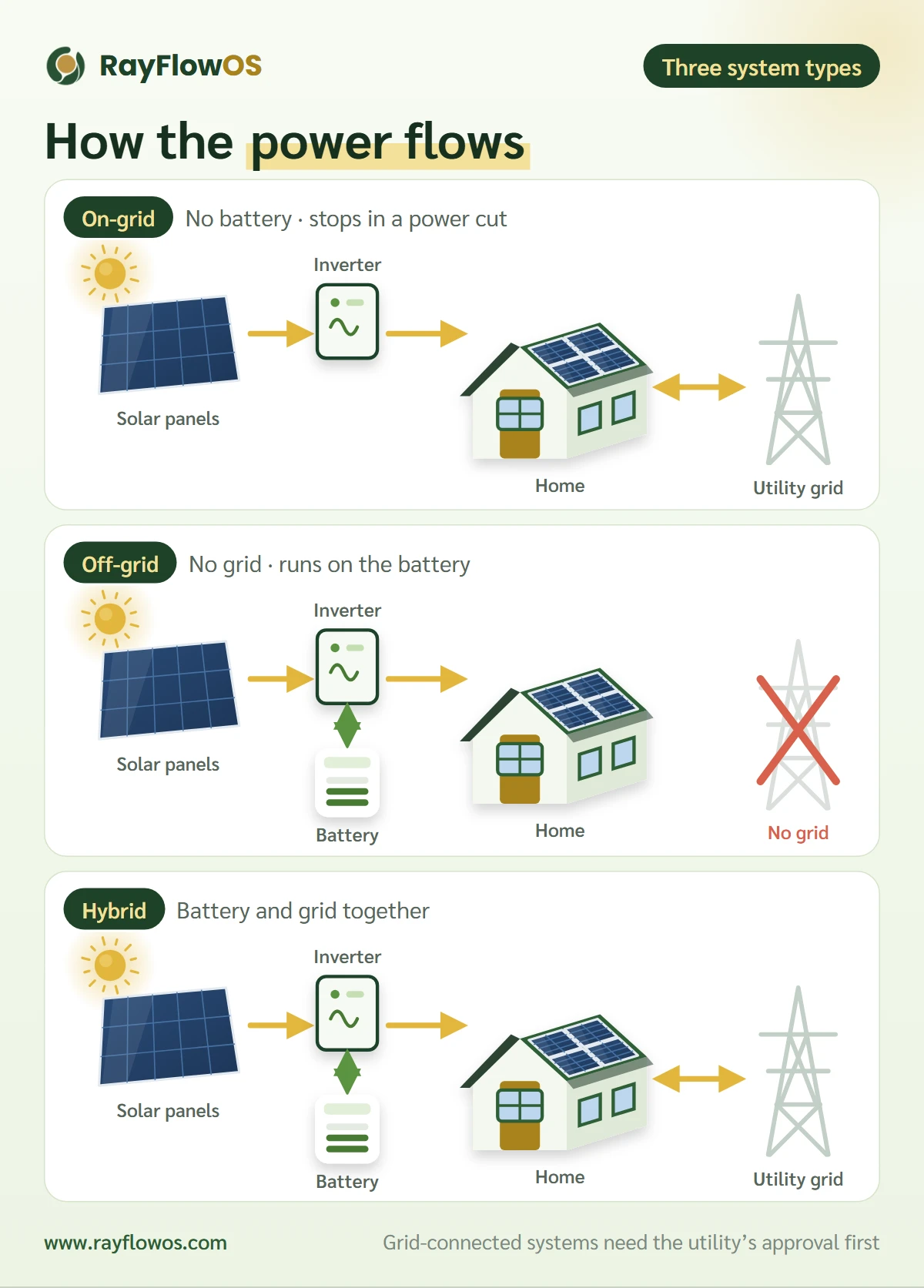
The panels produce direct current, and the inverter converts it to alternating current for the house. When the panels do not produce enough, the house draws the rest from the grid automatically; when they produce more than the house uses, the surplus flows out to the grid.
The key point: an on-grid system stops during a power cut, even in bright sunshine. The inverter must disconnect so it cannot push power into lines that utility crews are repairing.
Off-grid
There is no connection to the utility at all. The panels charge a battery, and the inverter draws from the battery to run the loads. It is used where the grid does not reach: farms, orchards, cabins or a water pump in the middle of a field.
The battery must cover all the hours without sun, including several cloudy days in a row, so it tends to be large and is the biggest cost in the system.
Hybrid
A mix of both: a battery plus a grid connection. In the daytime the house runs on solar while the battery charges; in the evening it draws from the battery first and switches to the grid when the battery reaches a set level. Many hybrid inverters also have a backup output that keeps essential loads running during a blackout.
The three systems side by side
| Topic | On-grid | Off-grid | Hybrid |
|---|---|---|---|
| Battery | None | Yes (large) | Yes |
| During a power cut | Stops | Runs on stored energy | Runs if it has a backup output |
| Grid connection | Yes, needs approval | No | Yes, needs approval |
| Budget | Lowest | High | Higher than on-grid |
| Best for | Heavy daytime use | No grid access | Heavy evening use or frequent outages |
Choosing a system: five questions to ask first
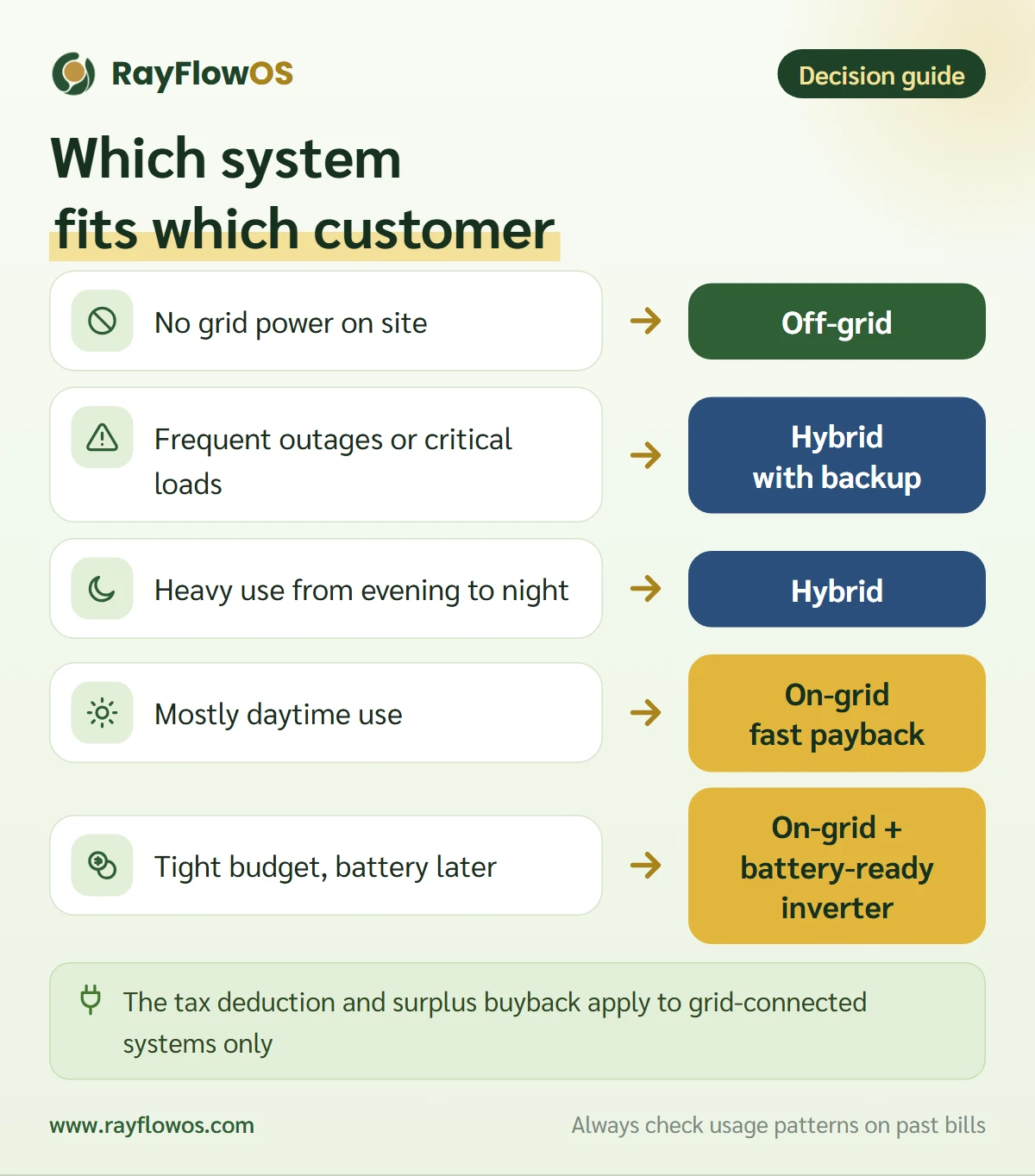
- When does the customer use the most power? Homes occupied in the daytime, shops and factories working daytime hours get the most from on-grid. Homes that use most power from evening to late night benefit more from a battery.
- How often does the power go out? Frequent outages or critical loads, such as freezers, medical equipment or network gear, point to a hybrid system with backup.
- Is there grid power at all? If not, off-grid is the only answer.
- What is the budget? The battery is a big cost. Many homes start on-grid and choose an inverter that can take a battery later.
- Which benefits does the customer want? Thailand's ฿200,000 solar tax deduction and the utility's surplus-buyback scheme apply only to grid-connected systems.
Can you sell surplus power back to the utility?
A grid-connected home can sell its surplus under Thailand's residential solar programme (โซลาร์ภาคประชาชน), which buys power on a net-billing basis at ฿2.20 per unit. That rate is below what households pay per unit, so using your own solar power is always worth more than selling it, which is why a system should be sized close to the home's daytime consumption.
The programme's details, such as the size accepted, the buyback period and the application window, change from time to time. Check with the Metropolitan or Provincial Electricity Authority before you quote.
What the installer needs to prepare
- Grid-connection approval: on-grid and hybrid systems must be approved by the utility before connection.
- An inverter the utility accepts: check that the model you quote is on the utility's accepted list; the Provincial Electricity Authority, for example, runs a registration system for inverter products.
- A sound roof: have an engineer check the structure first, especially on old roofs or roofs that have leaked.
- Battery systems: install the battery in a shaded, ventilated place within the manufacturer's temperature range. Choose the chemistry with our battery comparison and size it with our battery sizing guide.
Capturing what the customer wants in RayFlowOS
In RayFlowOS, the customer record holds the system size (kW) and battery size (kWh) the customer is interested in from the first contact. The site survey keeps photos and past electricity bills, and the quotation picks panels, inverters and batteries from your product list, so sales and installation teams see the same picture before anything is quoted.
FAQ
Does an on-grid system work during a power cut?
No. An on-grid inverter shuts down when the grid goes down, to protect the crews repairing the lines. For backup power you need a hybrid system with a backup output.
Can I add a battery to an existing on-grid system later?
Usually yes, depending on the existing equipment. Sometimes the inverter must be replaced with a hybrid model, or a separate battery charger added. Ask your installer to check the current model.
Is off-grid cheaper because it needs no utility approval?
Not necessarily. Off-grid needs a large battery, which usually makes it more expensive than an on-grid system of the same size, and it does not qualify for the tax deduction, which requires a grid connection.
Is hybrid worth it?
It pays off when the home uses a lot of power in the evening and at night, or needs backup. If most use is in the daytime, on-grid usually pays back faster; see our solar payback guide.
The bottom line
On-grid suits daytime users who want the fastest payback, off-grid suits places with no grid, and hybrid suits homes with heavy night-time use or a need for backup. Installers who ask about usage patterns and outages before proposing a system deliver systems customers stay happy with.
Start using RayFlowOS for free and record what each customer needs from day one →