
฿200,000 Solar Tax Deduction: What Thai Installers Must Issue
🌏 This article is available in another language: ไทย
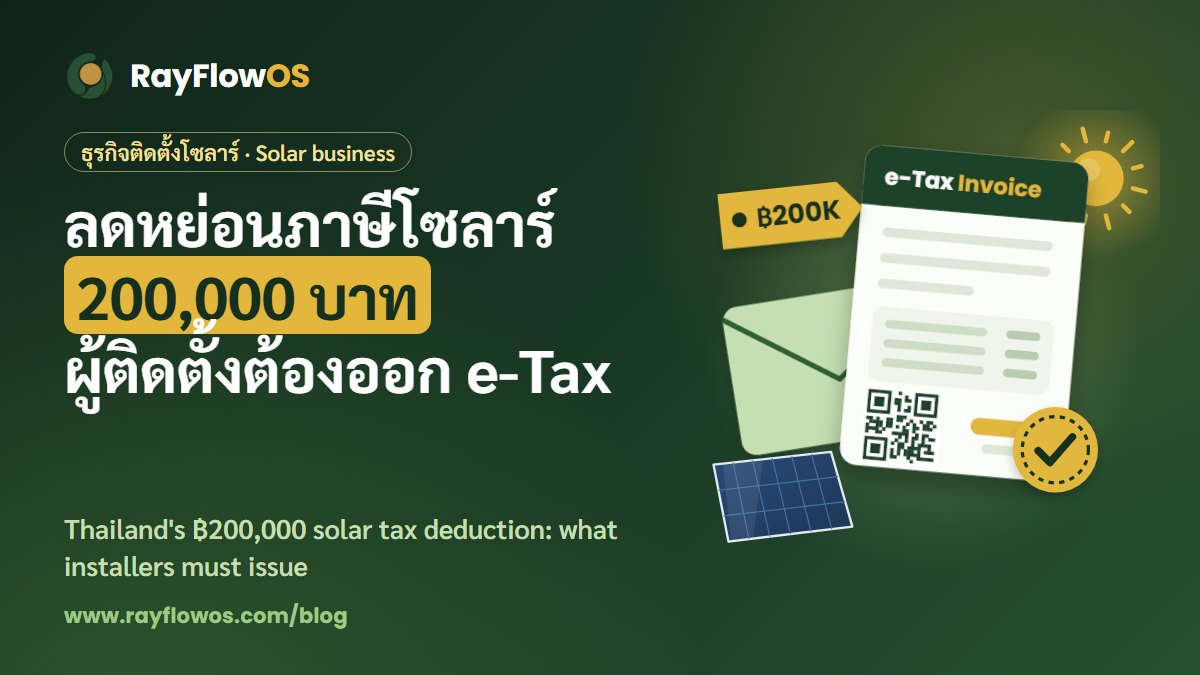
Thailand's rooftop solar tax deduction (Royal Decree 805) for installers: which systems qualify, what to collect and how to issue the e-Tax Invoice.
In 2026 almost every Thai homeowner asks a solar installer the same new question: "Can I deduct this from my taxes?" The government now lets individuals use what they pay for a rooftop solar system against their personal income tax, up to ฿200,000. That is good news for installers, but the benefit depends directly on the installer's paperwork. Get the documents wrong and the customer may not be able to claim at all.
This article walks through the measure from the installer's side: which systems qualify, what you need to collect from the customer, and how to issue an e-Tax Invoice the customer can actually use.
In short ✅ Individuals can claim what they actually paid, up to ฿200,000, for equipment and installation paid between 3 March 2026 and 31 December 2028 ✅ The system must sit on the roof or roof deck of a home, be no larger than 10 kW, and be connected to the grid ✅ The only accepted proof is an electronic tax invoice (e-Tax Invoice); paper invoices do not count ✅ The buyer on the invoice, the meter owner and the grid-connection applicant must be the same person ✅ Installers who can issue e-Tax Invoices will win these customers more easily
What is Thailand's solar rooftop tax deduction?
The measure is Royal Decree No. 805 (B.E. 2569) on tax exemptions, published in the Royal Gazette on 2 March 2026. It exempts from personal income tax the amount an individual pays for buying and installing a solar power system on the roof or roof deck of a building, up to ฿200,000.
People simply call it the "solar tax deduction". How much a customer saves depends on their tax bracket: someone in the 35% bracket who uses the full ฿200,000 saves about ฿70,000 in tax.
The conditions your customer must meet
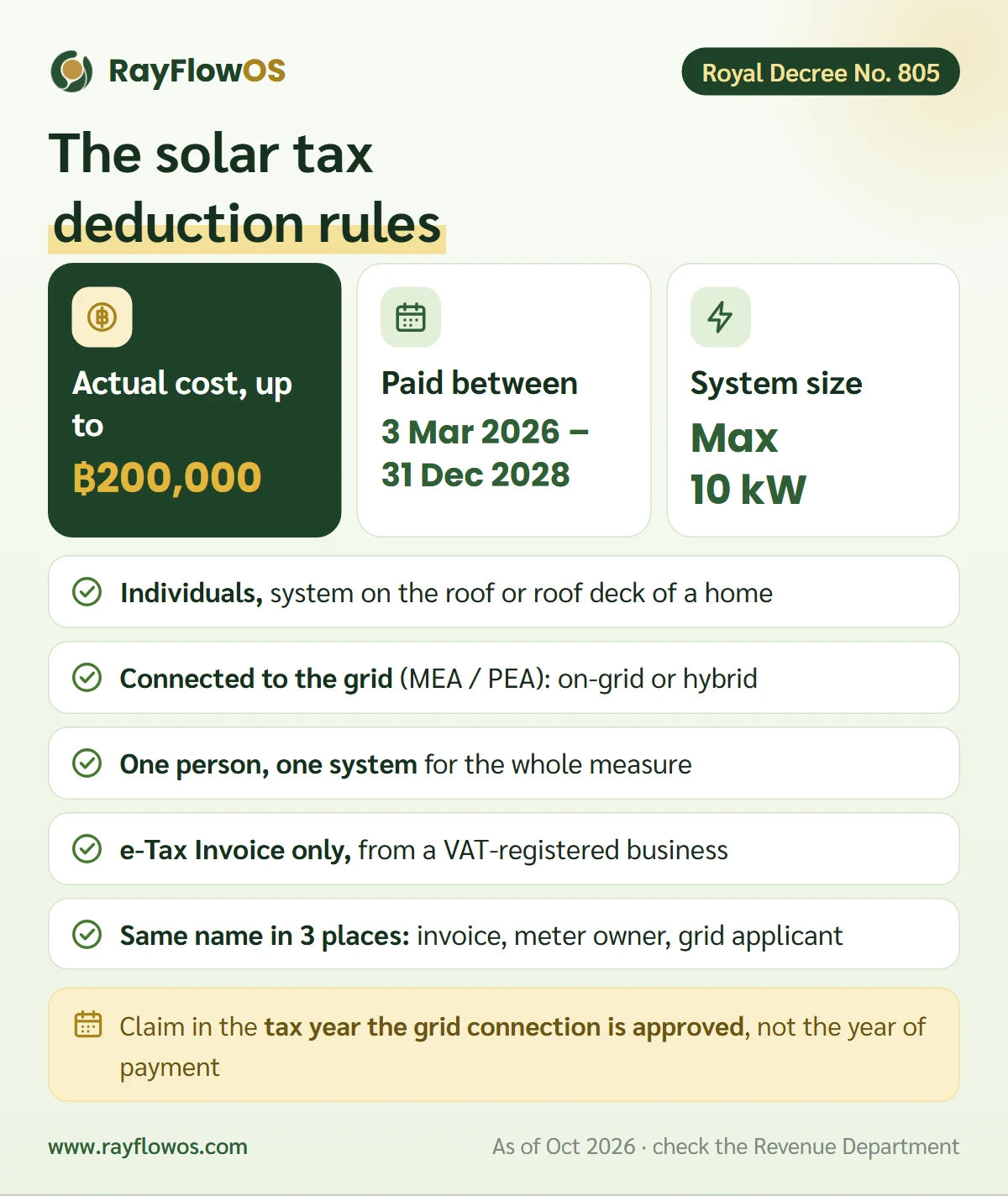
- An individual taxpayer. Ordinary partnerships, non-juristic groups of persons and undivided estates are excluded.
- Paid within the measure's window: 3 March 2026 to 31 December 2028. Earlier installations cannot be claimed retroactively.
- Installed on the roof or roof deck of a home, with a total size of no more than 10 kW per house.
- Connected to the utility grid of the Metropolitan Electricity Authority (MEA) or the Provincial Electricity Authority (PEA). On-grid and hybrid systems with an approved grid connection qualify; an off-grid system does not (see on-grid vs off-grid vs hybrid).
- One person, one system for the whole duration of the measure.
- An electronic tax invoice from a VAT-registered business.
- Matching names: the buyer on the tax invoice, the owner of the electricity meter and the person who applies for grid connection must be the same person.
Two more details customers often miss. The deduction is claimed in the tax year in which the utility approves the grid connection: pay in late 2026, get approval in early 2027, and the claim goes into the 2027 tax return. And the same expense cannot be used again for another tax benefit.
What installers need to prepare
1. VAT registration
Only VAT-registered businesses can issue tax invoices. An unregistered installer cannot give the customer a document that qualifies, and customers who plan to claim will choose someone else.
2. The ability to issue electronic tax invoices
The Revenue Department offers two main routes:
- e-Tax Invoice & e-Receipt, where the business sends the data to the Revenue Department itself or through a service provider.
- e-Tax Invoice by Time Stamp (formerly e-Tax Invoice by Email), aimed at businesses with revenue of up to ฿30 million a year, which email a PDF/A-3 file to be time-stamped.
Both require registration with the Revenue Department first. Check the department's website for the current requirements before you start.
3. Complete customer data from the quotation stage
Ask for a copy of the customer's electricity bill and use the meter owner's name as the buyer from the very first quotation, together with their 13-digit taxpayer ID, address and an email address for the invoice. If the person paying is not the meter owner, settle that early, because it is hard to fix later.
4. A system design that stays within the rules
Keep the system at 10 kW or less and connected to the grid. If a customer wants a bigger system because they use a lot of power, explain the effect on the deduction and ask them to confirm with the Revenue Department before deciding.
5. Help with the grid-connection application
The year of the claim depends on the utility's approval date, so a fast, complete connection application is a service customers value directly.
The paper trail, from quotation to tax return
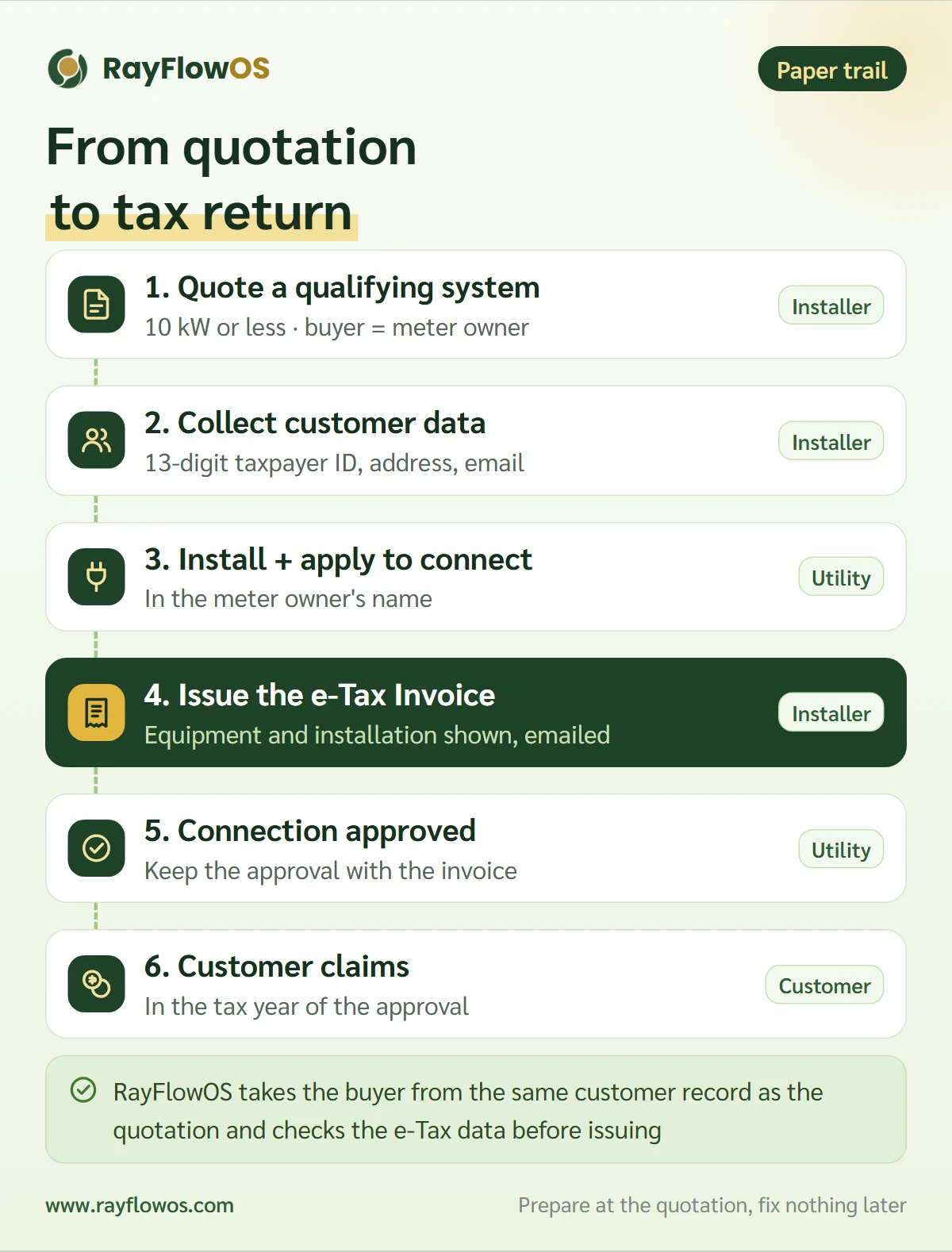
- Quote a qualifying system with the meter owner as the buyer.
- Collect the customer's taxpayer ID, address and email.
- Install and apply for grid connection in the meter owner's name.
- Receive payment and issue an e-Tax Invoice that separates equipment and installation, then email it to the customer.
- Keep the utility's connection approval together with the tax invoice.
- The customer claims in the tax year the connection was approved.
Mistakes that cost customers the deduction
- A paper invoice, or a plain PDF that never went through an e-Tax channel.
- The invoice in a son's or spouse's name while the meter belongs to the parents.
- A system over 10 kW without telling the customer.
- An off-grid installation that is not connected to the utility.
- The customer claiming in the year they paid instead of the year the connection was approved.
How RayFlowOS helps with e-Tax Invoices
On plans that include e-Tax, RayFlowOS produces the original tax invoice as a PDF/A-3 file with the XML data embedded, following the standard of Thailand's Electronic Transactions Development Agency (ETDA) for the e-Tax Invoice by Email / Time Stamp channel.
- Buyer details come from the same customer record as the quotation, so the names match from the start.
- Before releasing the file, the system checks that every field ETDA requires is present, such as the address, postcode and taxpayer ID, and lists anything missing.
- The receipt page shows the email subject line and copy recipient you need, ready to copy.
- Deposits that were already invoiced are deducted correctly on the final invoice.
- Electronic credit notes are available when an amount must be corrected after invoicing.
All of this lives in the finance menu where your team already records payments, so there is no second program to keep in sync.
FAQ
Can a paper tax invoice be used for the deduction?
No. The measure accepts electronic tax invoices only.
Can a 12 kW system qualify?
The rules set a limit of 10 kW per house. A larger system risks losing the benefit, so the customer should check with the Revenue Department before deciding.
Does a hybrid system with a battery qualify?
Yes, if it is connected to the utility grid and meets the other conditions. Having a battery does not exclude it.
The deposit was paid in 2026 but installation finished in 2027. Which year is the claim?
The tax year in which the utility approved the grid connection, not the year of payment.
Can a company use this measure?
No. It is for individuals; companies have separate tax incentives. Ask the company's auditor.
The bottom line
The ฿200,000 solar tax deduction makes the decision easier for homeowners, but every condition ends up in the installer's paperwork: matching names, system size and an electronic tax invoice. Installers who prepare for this from the quotation onward close deals faster and avoid fixing documents afterwards.
This article is general information as of October 2026. Check the Revenue Department's latest announcements before filing. Sources (in Thai): InfoQuest, "Power of The Act" on the solar tax exemption · KBank on solar tax savings
Start using RayFlowOS for free and get your solar sales ready for e-Tax →