
How to Write a Solar Quotation That Wins the Job: 10 Must-Haves
🌏 This article is available in another language: ไทย
What a winning solar quotation must show: equipment, savings, warranties and payment terms, plus how to price without losing money and manage revisions.
Most homeowners who want solar ask three or four installers for a quotation and lay them side by side. If yours says "5 kW system, lump sum" while a competitor lists the brands, models, warranties and the expected savings on the electricity bill, the customer will trust the one that answers their questions, even if it costs a little more.
This guide covers what a solar quotation should contain, how to price a job without losing money, and how to handle a quotation that gets revised again and again, so you close more deals and avoid arguments at handover.
In short ✅ A good quotation answers the customer's questions before they ask: what they get, what they save and what is guaranteed ✅ List the brand, model and quantity of every major component, never just "lump sum" ✅ Always state the assumptions behind any savings figure ✅ Every change is a new version, and the signed version is clearly marked ✅ Add an expiry date and the exclusions, so there is nothing to argue about when you collect payment
What a good solar quotation looks like
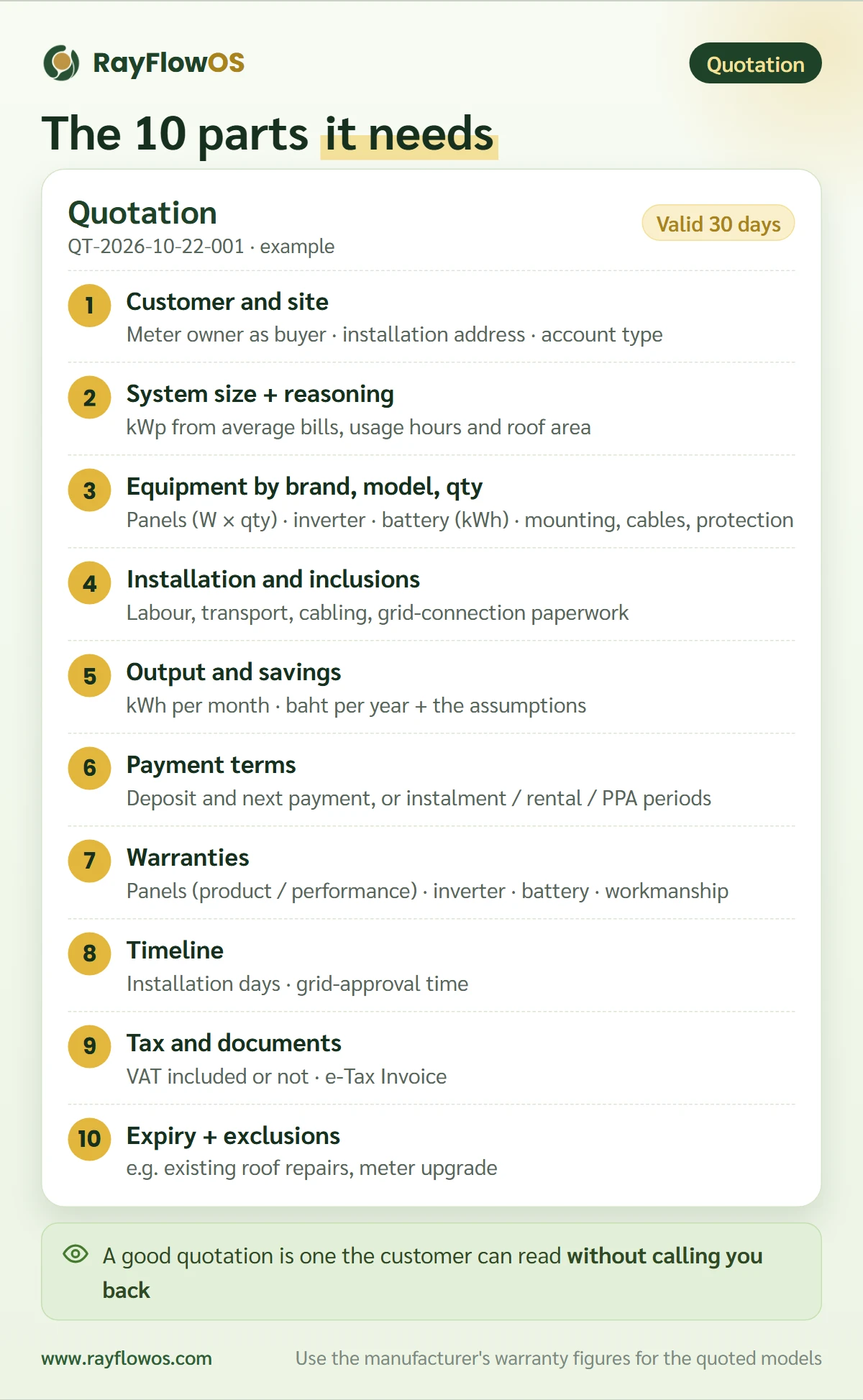
A quotation is not just a price. It is the document the customer uses to decide, and the agreement both sides return to during installation and when the invoice is due. The clearer it is, the less there is to interpret.
Ten things every solar quotation needs
1. Customer and site details
Use the name of the electricity meter owner, the installation address and the type of electricity account. If the customer plans to claim the solar tax deduction, getting the name right on the quotation keeps every later document right too.
2. System size, and where the number comes from
Give the size in kilowatt-peak (kWp) and a short explanation: the average monthly bill, when the household uses power, and the usable roof area from the site survey.
3. Equipment by brand, model and quantity
Panels (watts per panel × quantity), the inverter (size and type), the battery if any (kWh and chemistry), mounting, cabling and protection devices. This lets the customer compare your offer with others on equal terms.
4. Installation and what it includes
Labour, transport, cabling and the paperwork for the grid-connection application. You may show it as one line or several, but say what is included.
5. Expected output and savings
Estimate monthly production, the share the customer will use directly and the yearly savings, with the assumptions you used, such as peak sun hours per day and the price per unit. Our solar payback guide shows the full calculation.
6. Payment terms
The deposit percentage and when the next payment falls due, or, for instalments, rental or PPA, the number of periods and the amount per period (see how the sales models differ).
7. Warranties
Separate them clearly: the panel product warranty and performance warranty, the inverter warranty, the battery warranty in years or cycles, and your own workmanship warranty. Use the figures from the manufacturer's documents for the exact models you quote.
8. Timeline
How many days the installation takes and roughly how long the grid-connection approval takes, so the customer can plan.
9. Tax and documents
Whether prices include VAT and what kind of tax invoice the customer will receive. If you can issue e-Tax Invoices, say so; this year it is a reason to choose you.
10. Expiry date and exclusions
Equipment prices move quickly. State how long the quotation is valid and what is not included, such as repairs to the existing roof or a meter upgrade.
Pricing a job without losing money
Good pricing starts from the real cost of the job, not from a competitor's price.
- Equipment cost: the actual purchase price of the lot you will issue, not a price you remember from last year.
- Labour and travel: based on the days and crew size the job really needs.
- Hidden costs: scaffolding, crane hire, transport and permit paperwork.
- Overheads: a fair share of office costs per job.
- Target margin: then compare the resulting price per watt with the market to check it is sellable.
After every handover, compare the job's actual cost with the estimate in the quotation. It tells you which part of your pricing to adjust next time.
Handling many revisions without confusion
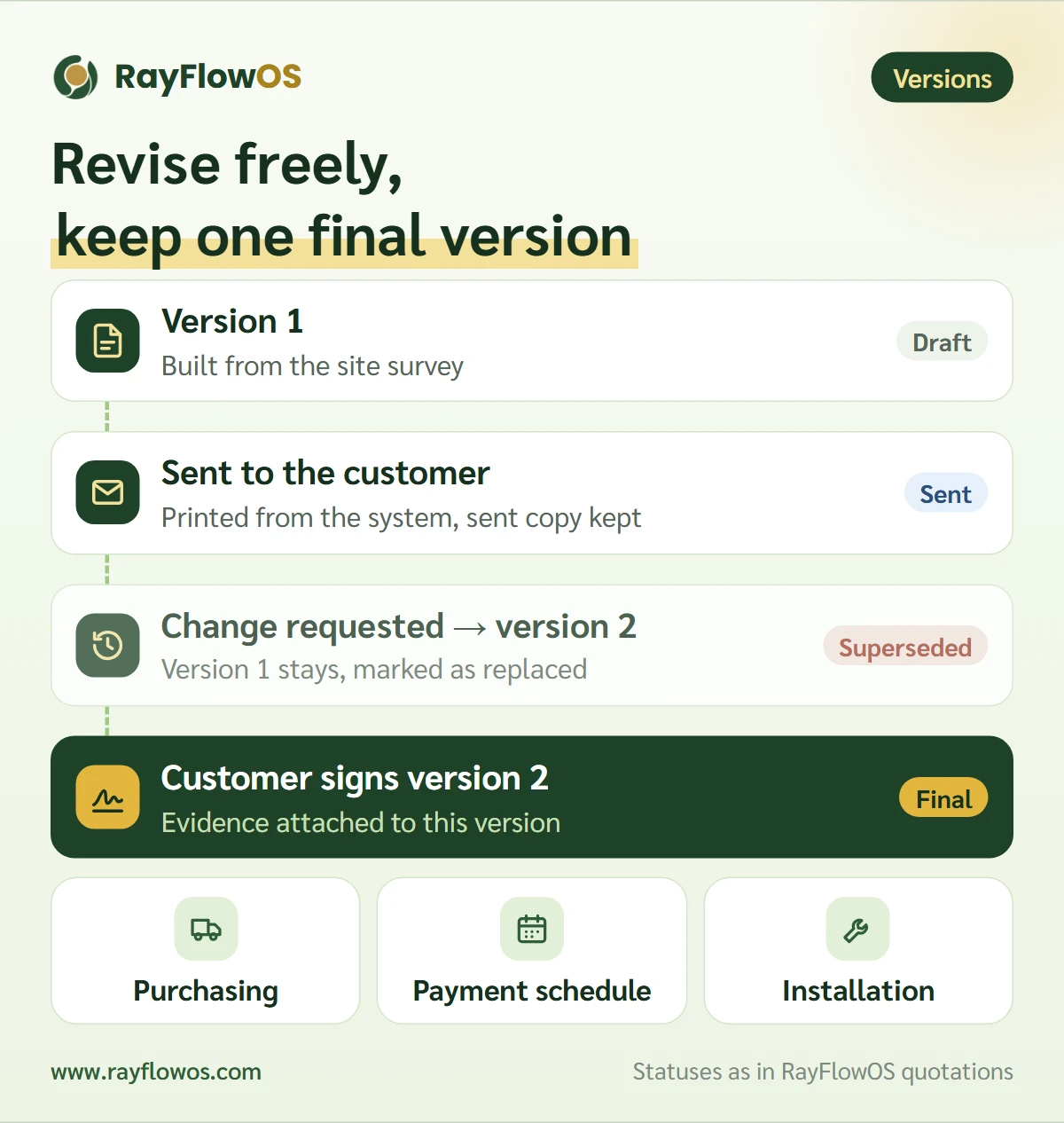
Customers often ask for a smaller system, a different battery brand or a discount. If you keep editing the same file, nobody will know which version was agreed. The rules are simple:
- A change means a new version. The old one is kept and marked as superseded.
- There is exactly one final version, the one the customer signed, with the evidence attached.
- Everything downstream starts from the final version: purchasing, the payment schedule and the installation job.
Quotations in RayFlowOS
In RayFlowOS, quotations live in the quotations menu and belong to the same customer record that holds the site survey, so the site data is at hand while you price.
- Pick equipment from your product list, with prices and units filled in.
- Choose one of four sales models: cash, hire purchase, rental or PPA.
- Clear statuses: draft → sent → final (confirmed by the customer). Every revision is a new version, and the old one is marked as superseded.
- Mark the final version, attach the signed evidence, and for hire purchase, rental or PPA the system generates the payment schedule.
- Print the quotation for the customer from the same page.
- Use the built-in solar calculator to estimate the number of panels from the roof area, the payback period and the monthly instalment before you put numbers on the quotation.
FAQ
How long should a solar quotation be valid?
There is no fixed rule. Most installers use a few weeks, because panel and battery prices change quickly. What matters is that the expiry date is written down.
Should I price each component separately?
At minimum, list the brand, model and quantity of the main components. The price can be one total, but the customer must know what equipment they are getting.
Should the quotation show the expected savings?
Yes, because savings are why customers buy solar. State the assumptions and make clear that it is an estimate, not a guaranteed result.
The customer asks for a discount after receiving the quotation. What now?
Issue a new version at the new price and have the customer confirm that version. Do not edit the figures in the old one.
Can I send quotations over LINE?
Yes, but send a file printed from your system and keep the sent version in the system, so you can always see what was sent and when.
The bottom line
A quotation that wins the job is one the customer can read without calling you back: what equipment, how much they save under which assumptions, how they pay and what is guaranteed. For your side, keeping every version and knowing exactly which one is final is what prevents trouble at installation and at payment time.
Start using RayFlowOS for free and send your first solar quotation →