
Cash, Hire Purchase, Rental or PPA: Choosing a Solar Sales Model
🌏 This article is available in another language: ไทย
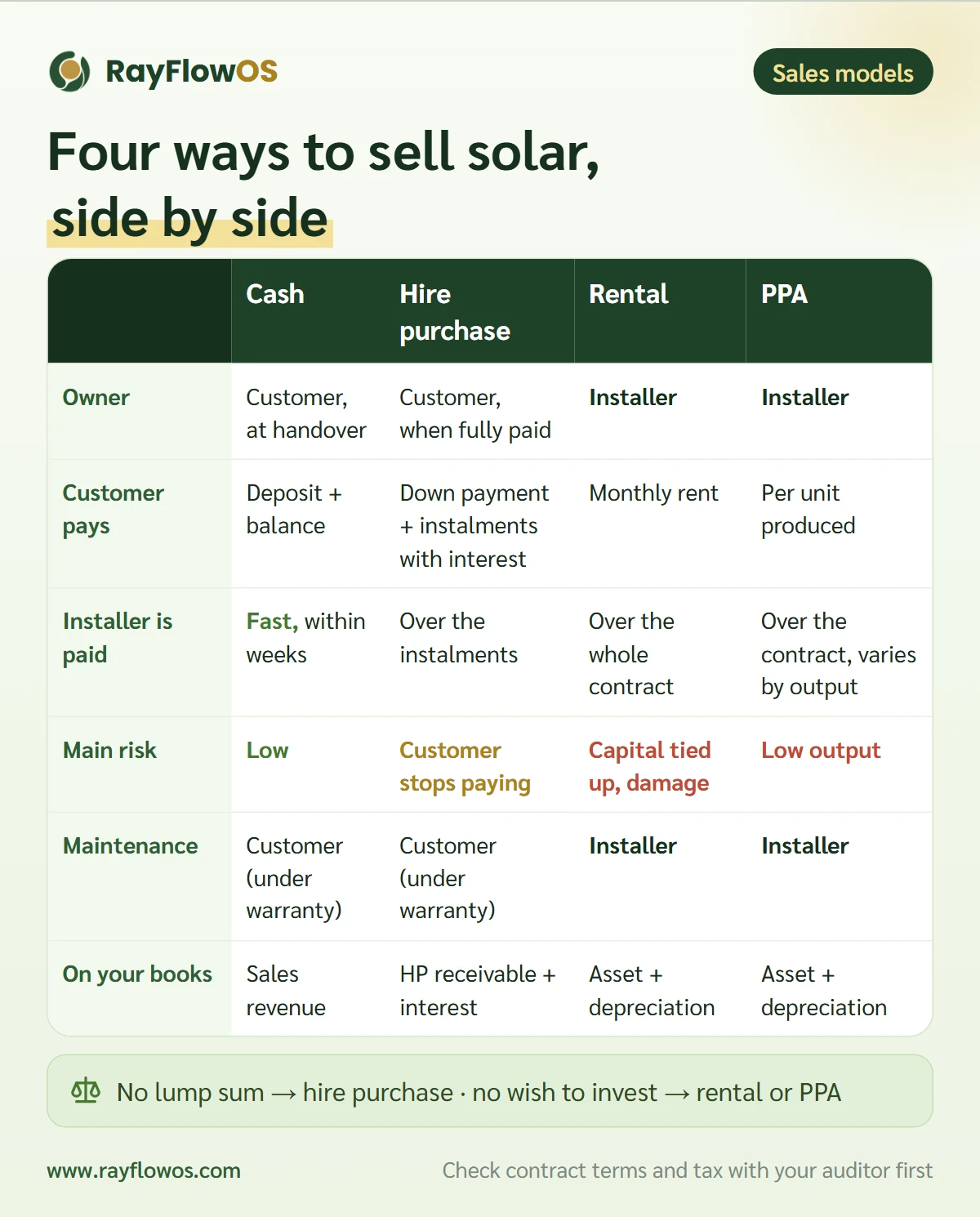
Four ways to sell solar compared: who owns the system, when the installer is paid, the risks and the accounting, and how to match the model to the customer.
Plenty of customers want solar but stall at the upfront cost. Some households would rather pay monthly than all at once, and some factories do not want another asset on their balance sheet at all. An installer who can offer more than one way to buy wins jobs that others cannot close.
Each model changes when money reaches your company, how much risk you carry and how the deal is booked. This article compares cash sales, hire purchase, rental and PPA in plain terms, and lists what to have in place before you offer each one.
In short ✅ Cash: the fastest money and the lowest risk, but the customer needs the full amount ✅ Hire purchase: the customer pays in instalments and owns the system at the end; you carry the credit risk ✅ Rental and PPA: you own the system, collect monthly for years and maintain it yourself ✅ Each model recognises revenue, output VAT and assets differently ✅ Offer instalments, rental or PPA only when your system can schedule and book them correctly
Four ways to sell solar, compared
Cash sale
The customer pays a deposit and the balance by job milestones, and owns the system at handover. It is the simplest model: you are paid in full within weeks, and after handover only your warranty obligations remain.
Hire purchase (instalments)
The customer pays a down payment and then monthly instalments that include interest. Ownership passes to the customer when the last instalment is paid. The customer gets the system without a large lump sum; you earn the interest but wait longer for your money and carry the risk that the customer stops paying.
Rental
The customer pays a monthly rent under a contract while you own the system for its whole term. That means you fund the equipment, maintain it and insure it. At the end of the term the contract is renewed, the system removed or ownership transferred, as agreed.
PPA (selling electricity by the unit)
PPA stands for power purchase agreement. You install and own the system; the customer pays only for the electricity it produces, at an agreed rate per unit that is usually below the utility's price. Some contracts add a monthly minimum. PPAs suit factories and buildings with high daytime consumption that do not want to invest themselves.
When the money arrives
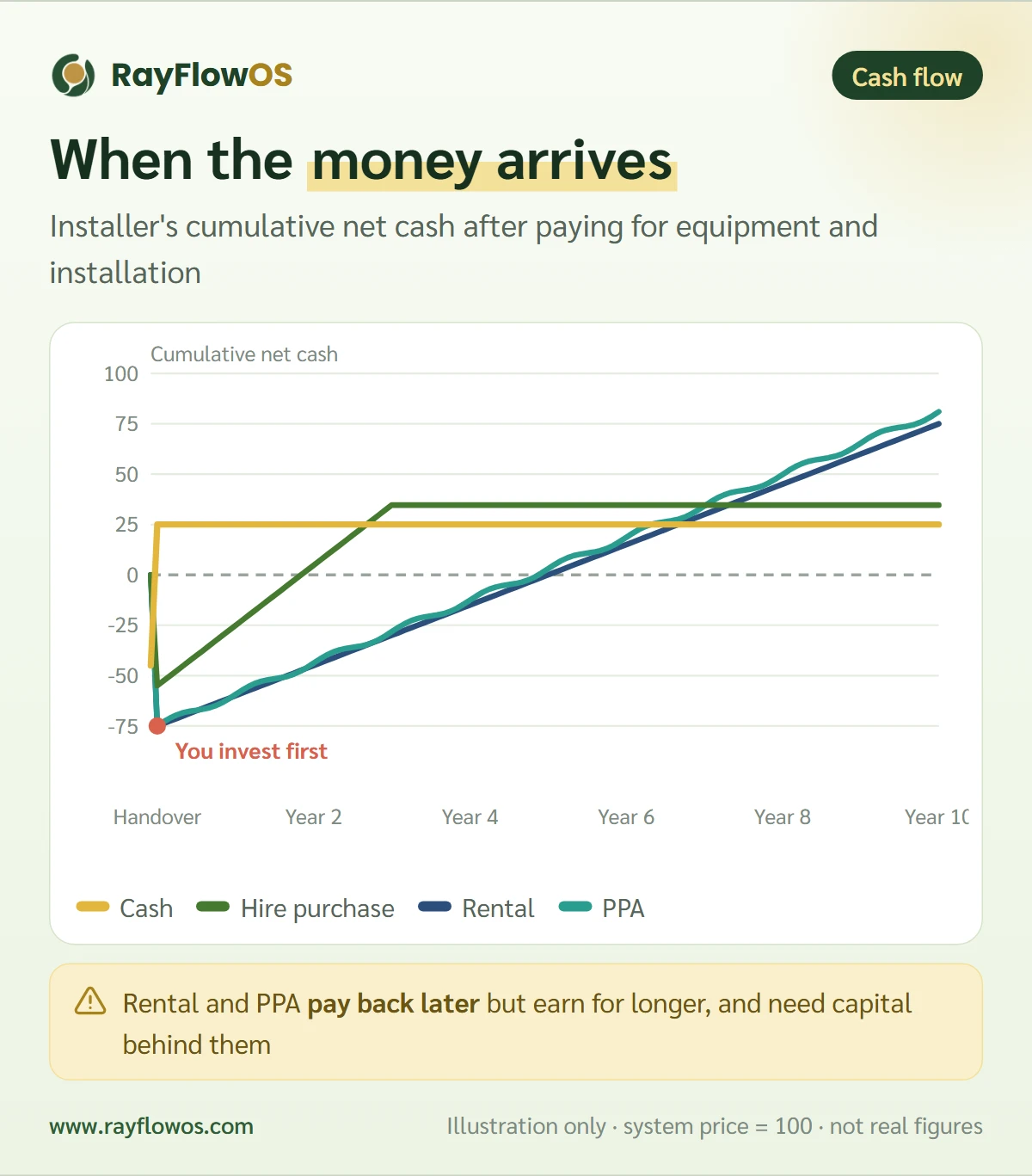
This picture is the heart of the decision. Cash sales return your money quickly, which suits companies with limited working capital. Rental and PPA give steady long-term income, but you need capital or financing first, because you buy and install the equipment with your own money.
Which model fits which customer
| If the customer is… | The model that usually fits |
|---|---|
| A homeowner with savings who wants to own the system now | Cash |
| A homeowner who prefers a monthly payment close to their bill savings | Hire purchase |
| A business that wants the system without investing | Rental |
| A factory or building with heavy daytime use that wants to pay per unit | PPA |
Your own readiness matters too. Hire purchase needs a credit check before approval. Rental and PPA need capital, a team that maintains systems for the whole contract and, for PPA, a reliable monthly meter reading.
Accounting and tax for each model
- Cash: revenue and cost are recognised at handover, or when the customer confirms the job, depending on the policy your company adopts. Deposits received earlier are a liability until handover.
- Hire purchase: a hire-purchase receivable is recorded at handover and the profit on the sale is recognised in the period of the sale, while the interest is recognised as income over the instalments. Under Thailand's Revenue Code (section 78(2)), output VAT on each instalment arises when that instalment falls due, and hire-purchase interest is part of the VAT-able price.
- Rental and PPA: the system is your asset. Materials and installation costs are capitalised and depreciated over its life, while rent and PPA charges are monthly income.
Agree the detailed bookkeeping with your auditor before you start selling, especially for hire purchase, where each instalment must be split into principal, interest and VAT.
Risks to control
- Customers who stop paying. Have a collection process, agree with your auditor how overdue instalments are booked, and decide whether to negotiate an early settlement or repossess.
- Lower output than expected, which hits PPA income directly. Plan routine maintenance (see our O&M checklist).
- Damage to systems you own. Insure them and know when each policy expires.
- Documents that disagree. Payment schedules, receipts and the ledger must come from the same data, or the outstanding balances will not match.
All four models in RayFlowOS
RayFlowOS supports all four models from the quotation onward (rental and PPA are part of higher plans).
- Quotations: choose cash, hire purchase, rental or PPA and enter the down payment, number of instalments, interest rate, monthly rent, or the PPA rate per unit and monthly minimum.
- Payment schedules: generated when the quotation becomes final. PPA periods are billed from the units recorded on each receipt.
- Hire purchase: the receivable is raised at handover, and interest and output VAT are booked at month-end close. A contract can be suspended when the customer stops paying, settled early, or repossessed back into stock.
- Rental and PPA: job costs are capitalised as a project asset and depreciated at month-end close.
- Contract ledger: every accounting entry of one contract on a single timeline, with the origin of each entry.
- Solar calculator: work out instalments and the customer's PPA savings before you quote.
FAQ
What is the difference between hire purchase and rental?
With hire purchase the customer owns the system once the last instalment is paid. With rental you own the system for the whole contract and maintain it.
How is a PPA customer charged?
By the units the system produced that month, multiplied by the agreed rate. Some contracts use a fixed rate, others a discount on the utility tariff, and some add a monthly minimum.
Is VAT charged on hire-purchase interest?
Yes. In a hire-purchase contract the interest is part of the price of the goods, unlike interest on a loan.
What should we do when a customer stops paying instalments?
Follow your collection process, ask your auditor how to book the overdue periods, and then decide between an early settlement and repossession. RayFlowOS has tools for suspending interest and VAT on a contract, early settlement and repossession into stock.
Which model should a small company start with?
Start with cash sales until your processes run smoothly, then add hire purchase. Rental and PPA fit once you have the capital and a long-term maintenance team.
The bottom line
Sales models are a powerful way to close deals, but each one brings obligations. Cash is simple and fast; hire purchase adds income and risk; rental and PPA build long-term revenue at a high capital cost. Match the model to the customer and to your company's readiness, and make sure your operations and accounting support it before you sell.
Start using RayFlowOS for free and quote the model your customer wants →