
How to Calculate Solar Payback Period, With a Worked Example
🌏 This article is available in another language: ไทย
A step-by-step solar payback formula with a worked 5 kWp example, the factors that speed it up or slow it down, and how to present it credibly.
"How many years until it pays for itself?" Almost every customer asks, and installers answer differently: one says three years, another says seven, and the customer has no idea whom to believe. The problem is rarely the arithmetic. It is the assumptions nobody states.
This guide explains how to calculate the payback period of a solar system step by step, with a worked 5 kWp example you can follow, the factors that make payback faster or slower, and how to present the numbers so customers trust them.
In short ✅ Payback period = investment ÷ net savings per year ✅ Savings come mainly from solar power you use yourself; exported power earns far less ✅ The self-consumption share matters most; a system larger than the daytime load pays back more slowly ✅ State every assumption: sun hours, price per unit and maintenance cost ✅ Customers who qualify for the tax deduction pay back even faster
What is the solar payback period?
The payback period is the number of years until the money saved on electricity equals the money invested in the system. After that, every baht saved is the customer's profit. Panels carry performance warranties of decades, so a system that pays back in a few years keeps earning for a long time.
The most common formula is:
Payback (years) = investment ÷ net savings per year
It is simple and instantly understandable, but its accuracy depends entirely on the numbers you put in.
Step by step, with a 5 kWp example
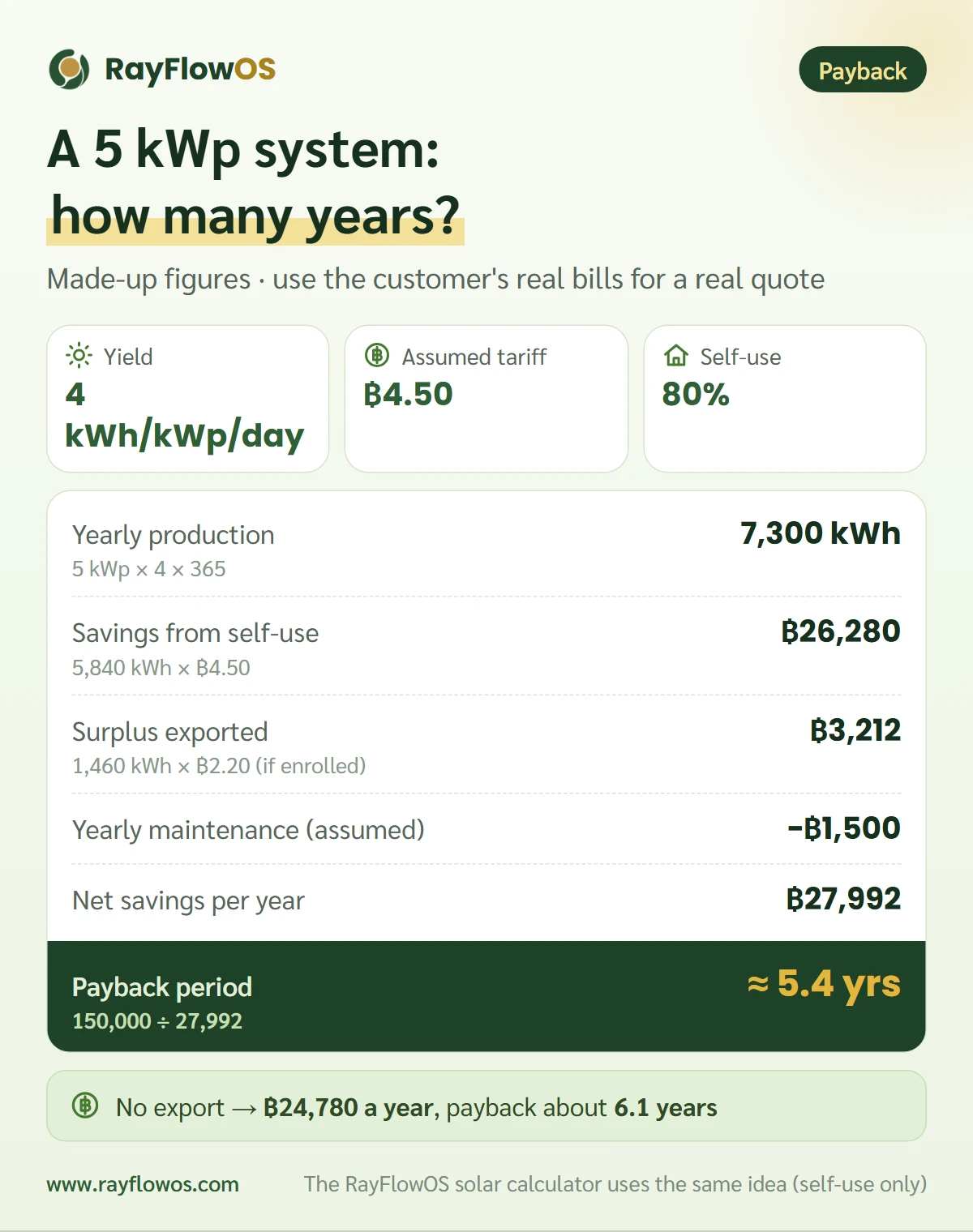
The figures are made up to show the method. For a real quotation, use each customer's own data.
Step 1: Estimate yearly production
Studies of rooftop systems in Thailand report roughly 3.4–4 kWh per kWp per day, depending on orientation, shading and location (a model of grid-connected PV in Thailand). This example uses 4.
5 kWp × 4 kWh × 365 days = 7,300 kWh per year
Step 2: Split self-consumed and exported power
Part of the solar output is used by the home immediately; the rest flows to the grid. The share varies widely with usage habits and can be read from a time-of-use meter or the inverter's app. This example assumes 80% is used directly.
Step 3: Turn it into money
- 5,840 kWh used directly × an assumed ฿4.50 per unit = ฿26,280
- 1,460 kWh exported × ฿2.20 = ฿3,212 (only if the home is enrolled in the utility's buyback scheme)
Step 4: Subtract yearly maintenance
For example cleaning and inspection, assumed here at ฿1,500 a year, giving net savings of about ฿27,992 a year.
Step 5: Work out the payback
150,000 ÷ 27,992 ≈ 5.4 years
Without the export income, net savings fall to ฿24,780 a year and the payback becomes about 6.1 years.
Savings over the system's life
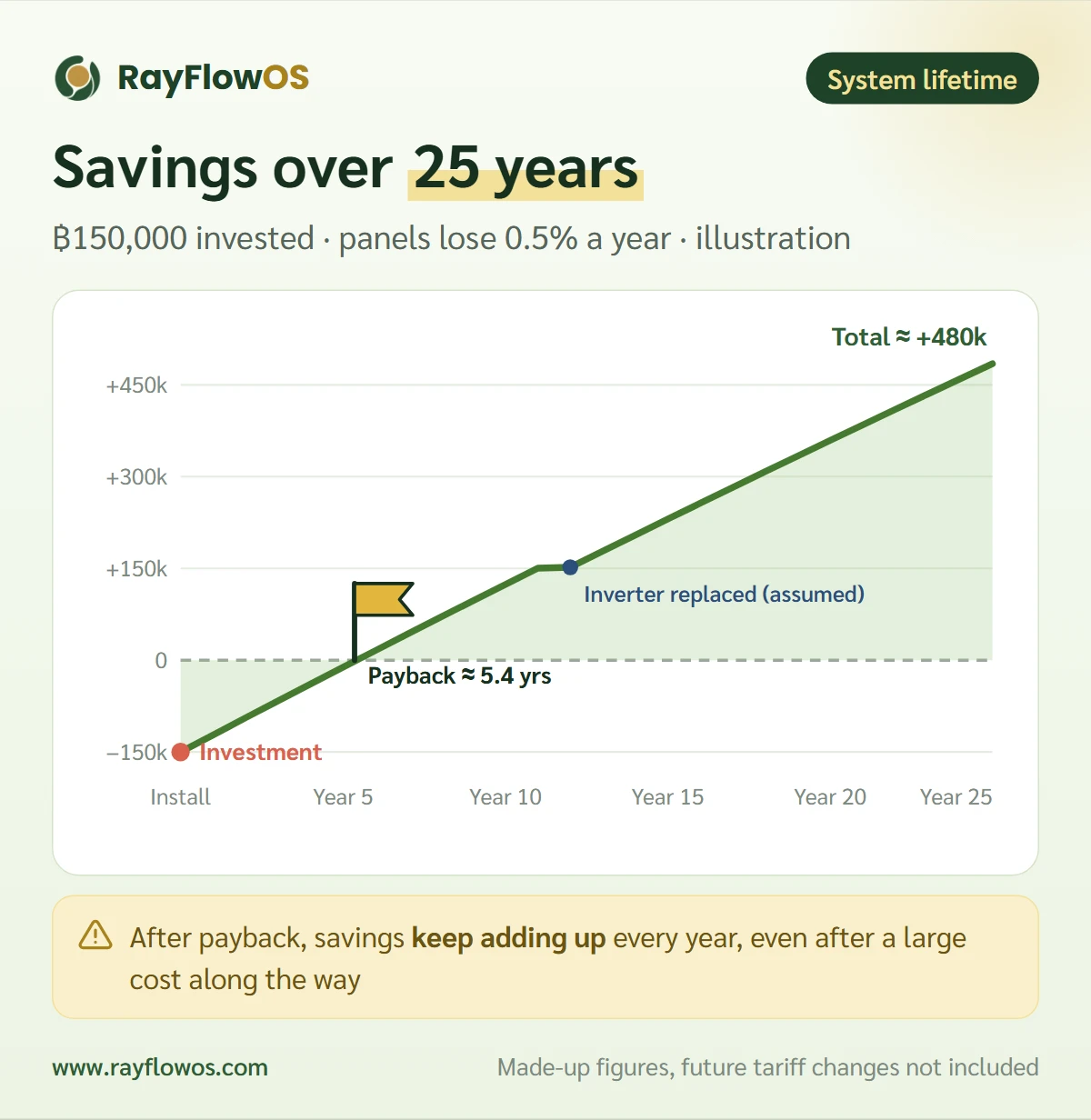
After break-even, savings keep accumulating every year, even as the panels produce slightly less with age and even after a large cost such as an inverter replacement along the way. Showing this picture helps customers see the whole return, not just the payback year.
What makes payback faster or slower
- Self-consumption share. Power you use yourself is worth the full tariff; exported power earns much less. A system oversized for the daytime load pays back more slowly.
- Electricity price. Higher tariffs mean bigger savings. Thai tariffs move with the Ft charge, which is reviewed periodically.
- Orientation and shading. In Thailand a south-facing, unshaded roof produces the most.
- System price, including equipment, installation and paperwork.
- Ageing. Panels produce slightly less every year, as set out in their performance warranty, and inverters usually need replacing before the panels.
- The tax deduction. Individuals who qualify for the ฿200,000 solar tax deduction recover tax at their own bracket. Someone in the 20% bracket who claims a ฿150,000 system saves about ฿30,000 in tax, which cuts the net investment.
Payback with a battery
A battery raises self-consumption by storing surplus solar for the evening, but it also adds a large investment. The clearest approach is to treat the battery as a separate investment:
Battery payback = battery price ÷ (energy shifted to the evening per year × (tariff − buyback rate))
Batteries make more sense when the home uses a lot of power in the evening and at night, or needs backup. See our battery sizing guide.
Presenting payback so customers believe it
- Use the customer's real bills, at least six to twelve months.
- Write every assumption on the quotation: sun hours, price per unit, self-consumption share and maintenance.
- Give a range, not a single number: conservative, expected and good cases.
- Do not guarantee savings, because they also depend on how the customer uses power.
Our solar quotation guide covers how to put it all on paper.
The solar calculator in RayFlowOS
RayFlowOS includes a solar calculator that lets salespeople estimate the numbers while talking to the customer:
- Roof area → number of panels → system size, from roof width, length, usable share and panel size.
- Bill savings and payback, from system size, sun hours per day, price per unit, self-consumption share and investment.
- Instalment amount, from system price, down payment, number of instalments and interest.
- The customer's PPA savings when you sell power per unit instead of the system.
Once you have the numbers, build the quotation in the same system.
FAQ
How many years does home solar take to pay back?
It depends on the system price, the tariff and the self-consumption share. The example here pays back in about five to six years, but homes vary a lot, so calculate from real bills.
Does selling surplus power speed up payback much?
A little, but not much, because the buyback rate is below the price the home pays. Designing for maximum self-consumption works better.
Does a tariff increase shorten payback?
Yes, because every unit you produce yourself is worth more. If tariffs fall, payback gets longer.
Why do installers quote different payback periods?
Because they use different assumptions, such as sun hours, price per unit, or assuming that all output is used directly. Ask for every assumption and compare like with like.
Should the inverter replacement be included?
Yes, if you look at returns over the system's whole life. Inverters have shorter lives than panels and usually need replacing along the way.
The bottom line
Solar payback is easy to calculate, but it is only credible when it comes from real bills and states every assumption. Self-consumption matters most; the tax deduction and surplus sales are bonuses. Installers who can explain where their numbers come from earn more trust than those who simply quote an attractive figure.
Start using RayFlowOS for free and try the solar calculator with your next customer →