
Solar Inventory: Serial Numbers and FIFO Costing for Installers
🌏 This article is available in another language: ไทย
Control panel, inverter and battery stock so warranty claims succeed and job profits are right: serial tracking, stores by condition and FIFO lot costing.
A customer's inverter fails two years after installation and they call to ask when the replacement will arrive. The first thing the distributor asks you is: which serial number, which purchase order, and when did the warranty start? If you cannot answer, the claim is slow, or worse, rejected, and the replacement comes out of your own pocket.
Solar panels, inverters and batteries are expensive items, and every one of them carries a serial number. Counting quantities is not enough. This article explains serial-number tracking, splitting stock by condition, and FIFO costing based on the lots you actually bought.
In short ✅ Track key equipment by serial number, from goods receipt to the customer's roof ✅ Keep good, returned, claim and damaged stock apart, so unusable units never reach a job ✅ Cost issued stock at the real purchase price of its lot, not a remembered "standard cost" ✅ Link every stock issue to a job, or the job's cost is incomplete ✅ Correct posted documents with reversals, never by deleting them
Why solar stock needs tighter control
- Each unit is expensive. One battery missing from the books can wipe out the profit of a small job.
- Warranties are tied to serial numbers. Manufacturers always ask for the serial and proof of purchase.
- Goods arrive in lots. One order can arrive in several deliveries, and each lot may cost a different price.
- Stock flows backwards too. Leftovers from a site, customer returns and claims all need a known location.
What serial numbers are for
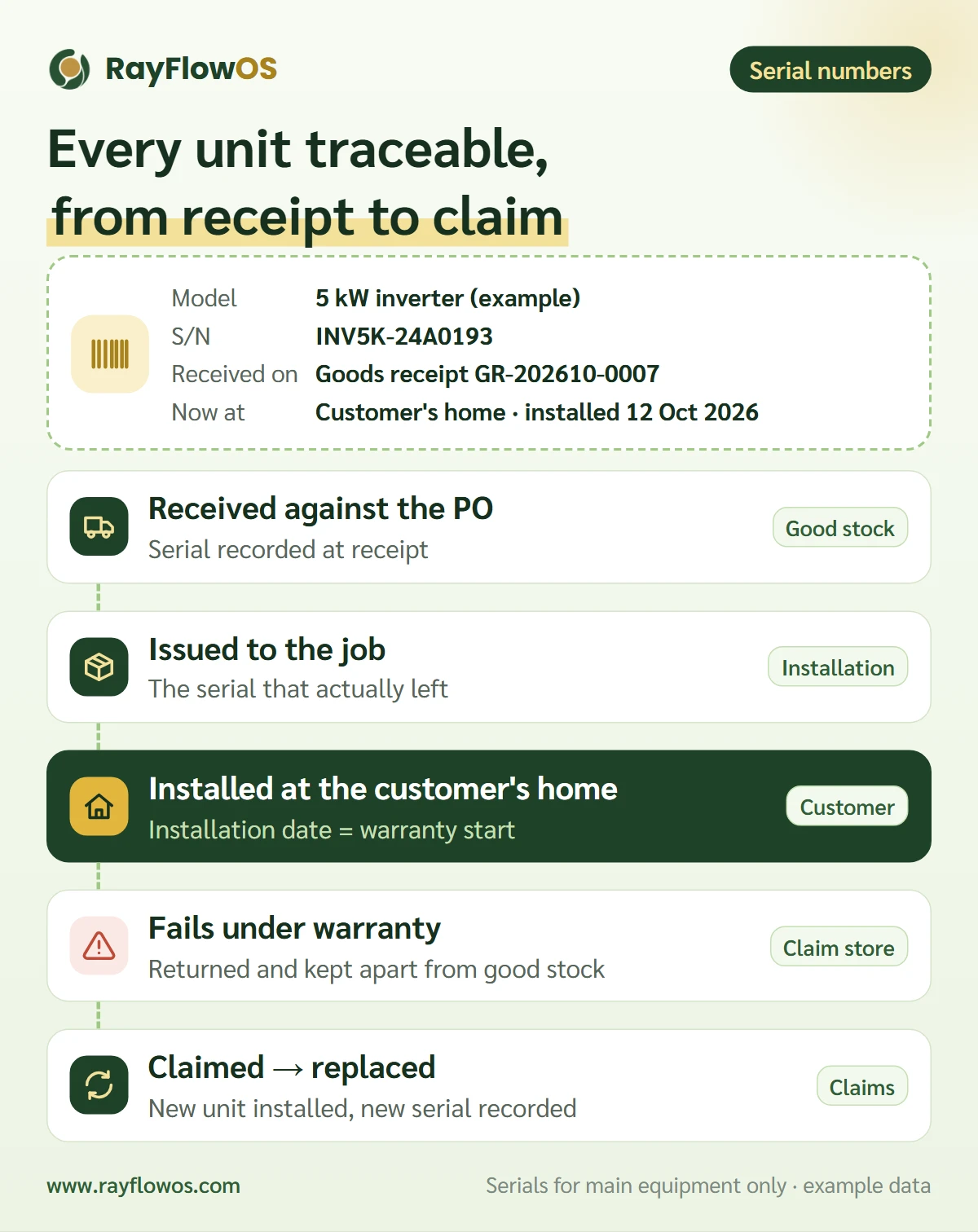
A serial number identifies one physical unit. Record it on the day the goods arrive and you can answer instantly:
- Which supplier, which purchase order and what price this unit came from.
- Whether it is in the warehouse, at a particular customer's home, or out on a claim.
- When it was installed, which is when the customer's warranty starts (after-sales care and claims are covered in our maintenance checklist).
You do not need serials for everything. Cables, brackets and bolts are fine as quantities. Track the main equipment, such as panels, inverters and batteries, and mark in your product list which models need a serial.
Split stock by condition
| Store | What it holds | Can it go to a job? |
|---|---|---|
| Good | New, ready-to-use stock | Yes |
| Returned | Site leftovers and customer returns awaiting inspection | After inspection |
| Claim | Faulty units to send back to the manufacturer | No |
| Damaged | Unusable units that cannot be claimed | No |
This stops a crew from picking up a unit awaiting a claim and installing it at a new customer's home, and it makes the "good stock on hand" figure your sales team relies on trustworthy.
FIFO costing by lot
FIFO means first in, first out: the units received first are treated as issued first, so the cost of issued stock comes from the oldest lot before moving on to the next.
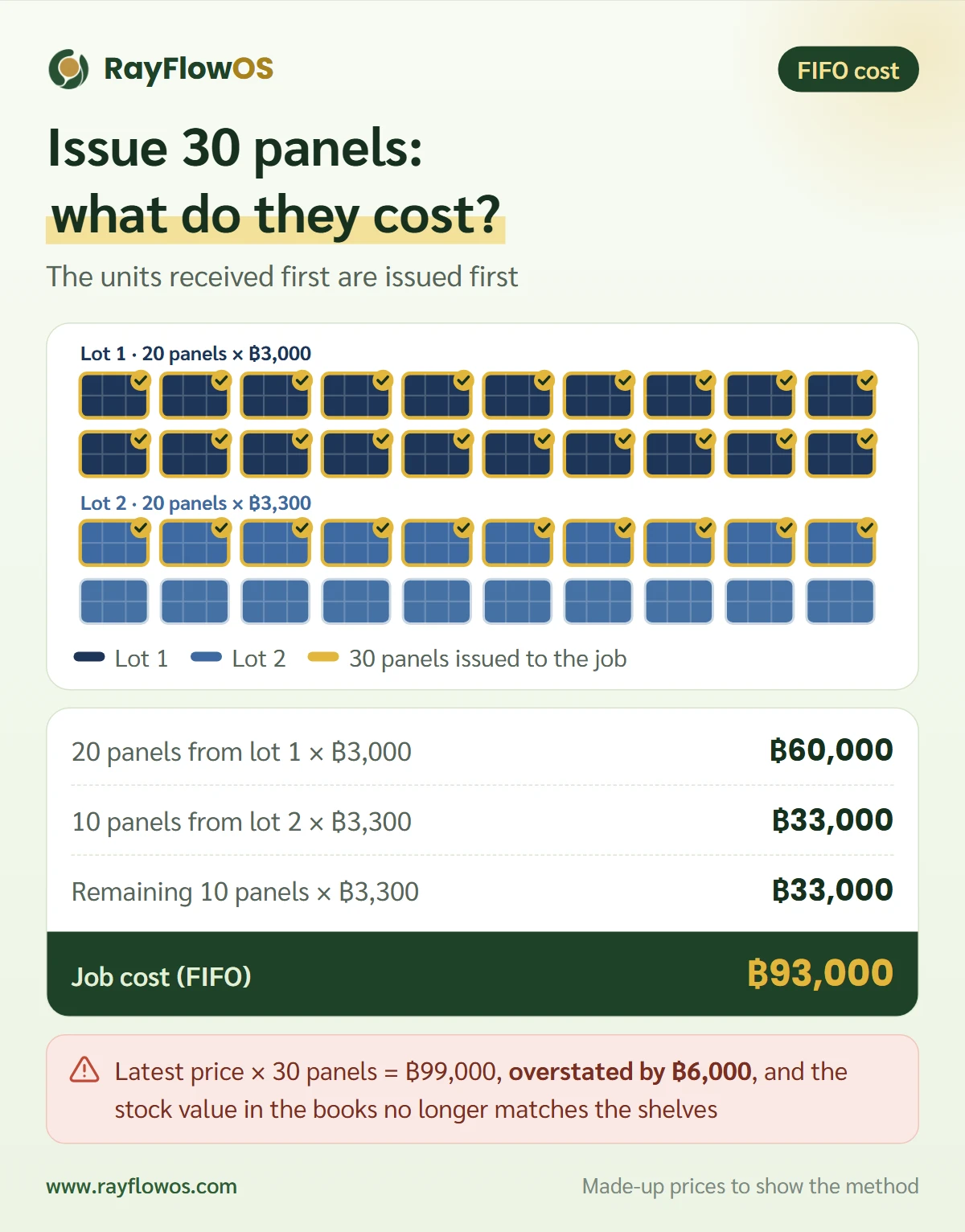
The prices in this example are made up. If you multiplied all 30 panels by the latest price instead, the job cost would be ฿99,000, overstated by ฿6,000, and the stock value in your books would no longer match the stock on your shelves.
For serial-tracked equipment, the most accurate cost is the price of the lot that unit actually arrived in, because you know exactly which receipt it came from.
A warehouse process that works
- Receive against the purchase order. Record the quantity that actually arrived and the serials of the main equipment. Partial deliveries are received in lots.
- Issue to a job. Every stock issue belongs to an installation job, and you pick the serials that actually left.
- Return leftovers. At the end of the job, unused items come back with their condition noted.
- Move faulty units to the claim store and follow the claim until the replacement arrives.
- Count regularly. When a count differs from the system, adjust with a reason and book the difference.
- Fix mistakes with reversals. Never delete the original, so the history can always be audited.
Common mistakes
- Issuing stock without a job, so the cost lands in general expenses and every job looks more profitable than it is.
- Skipping serials at goods receipt and trying to note them at installation, where they get lost.
- Costing from a standard cost in the product list that nobody updates.
- Handing over a job before any stock was issued to it, leaving its cost at zero.
- Deleting a mistaken goods receipt, after which the ledger and the stock never match again.
Solar stock control in RayFlowOS
RayFlowOS covers every step above with its warehouse menus: goods receipts, stock issues, stock returns, stock management and product claims.
- In the product list, mark which models are serial-tracked; the system then requires serials at goods receipt and at stock issue.
- Four stores by condition: good, returned, claim and damaged.
- Issued stock is costed FIFO by goods-receipt lot. Serial-tracked units use the price of the lot they arrived in, and a draft stock issue shows the estimated FIFO cost before anything leaves.
- Stock value is calculated from the lots actually remaining, so it matches the inventory balance in the ledger.
- A job cannot be handed over without a completed stock issue, so its cost never disappears.
- A purchase order that has already been received is cancelled by reversal, keeping the original documents.
FAQ
Do I need serial numbers for every product?
No. Track the main equipment with per-unit warranties, such as panels, inverters and batteries. Consumables can be counted as quantities.
What is the difference between FIFO and average cost?
FIFO costs issues from the oldest lot first, in the order received. Average cost blends all lots together. Both are acceptable as long as you apply one method consistently; FIFO suits businesses that want job costs to follow the actual purchase price of each lot.
How often should we count stock?
Count expensive main equipment monthly; consumables can be counted quarterly. The more often you count, the sooner you catch errors.
What should we do with leftovers from a site?
Return them to the warehouse with their condition: good items go back to good stock, items that need checking go to the returned store, and the job's cost falls by what came back.
We posted a goods receipt by mistake. How do we fix it?
Cancel it with a reversal and post a correct one. The original stays as evidence; it should never be deleted.
The bottom line
Good solar stock control can always say where each unit is, which purchase order it came from and what it cost. Capturing serials at receipt, separating stock by condition and costing by real lots makes both warranty claims and job-profit reports match reality, and when the warehouse lives in the same system as sales and accounting, the data flows as one chain (see what solar business software should cover).
Start using RayFlowOS for free and receive your first lot with serial numbers →